
Trader Joe’s Target Market Analysis
Jul
Understanding a company’s target market is essential for crafting effective marketing strategies, developing the right products, and building long-term customer loyalty. By identifying and analyzing specific customer segments, brands can align their offerings with audience preferences and values. For retailers, especially in the highly competitive grocery sector, precise market targeting determines more than just sales—it shapes brand identity.
Trader Joe’s is a standout in the American grocery landscape. Known for its curated product selection, quirky branding, and value pricing, Trader Joe’s business model has cultivated a fiercely loyal customer base. Unlike traditional supermarkets that compete on variety or convenience, Trader Joe’s focuses on a distinct shopping experience that emphasizes quality, affordability, and uniqueness. This approach is deeply connected to its core audience—who they are, what they value, and how they shop.
In this article, we’ll explore the Trader Joe’s target market through a detailed lens. We’ll examine who their ideal customers are, how the company segments and communicates with them, and how Trader Joe’s compares to major competitors like Whole Foods and Aldi. From demographics to psychographics, this analysis will uncover what makes Trader Joe’s appeal so enduring and effective—and where it may face challenges in the evolving retail market.
Contents
Who is Trader Joe’s Target Audience?
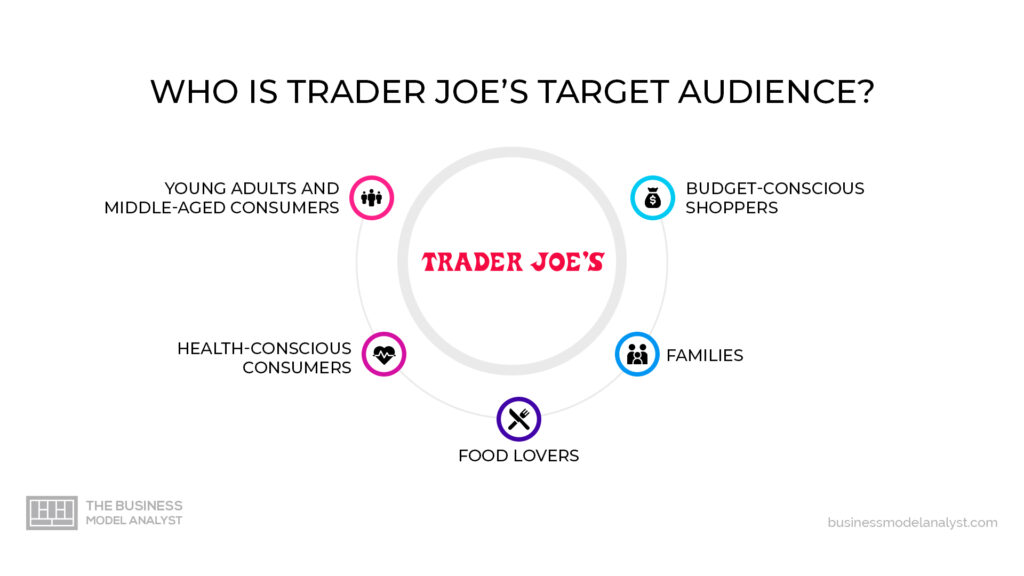
The Trader Joe’s target market centers on urban and suburban, health-conscious consumers who seek quality, affordability, and novelty in their grocery shopping experience. Typically, these shoppers are aged 25 to 45, with a strong presence among millennials and younger Gen X. Many are college-educated, middle to upper-middle class, and live in metropolitan or affluent suburban areas.
Trader Joe’s appeals to customers who value simplicity and authenticity over mainstream branding. The store’s private-label products and absence of traditional advertising resonate with shoppers who appreciate curated experiences and trust in-store recommendations. This demographic often leans toward healthier lifestyles, with interests in organic foods, plant-based options, and sustainability.
Income-wise, Trader Joe’s caters to individuals earning $50,000 to $100,000 annually, though its pricing model attracts both frugal shoppers and those who can afford higher-end alternatives but choose Trader Joe’s for its perceived value. Shoppers often describe the experience as “fun,” indicating an emotional connection that goes beyond product quality.
A real-world example is the “young professional couple” living in cities like Portland, Austin, or San Diego. They buy almond butter, meal kits, and sparkling water on a weekly trip to Trader Joe’s—not just because it’s affordable, but because it aligns with their values of health, efficiency, and discovery. Trader Joe’s uniquely caters to this segment by blending lifestyle fit with affordability.
Trader Joe’s Target Market Segmentation and Marketing
Market segmentation involves dividing a broad consumer or business market into sub-groups based on shared characteristics. This allows brands to tailor products, messaging, and marketing strategies to better align with each segment’s specific needs. Trader Joe’s excels at segmentation, using it to maintain strong emotional and practical connections with its audience.
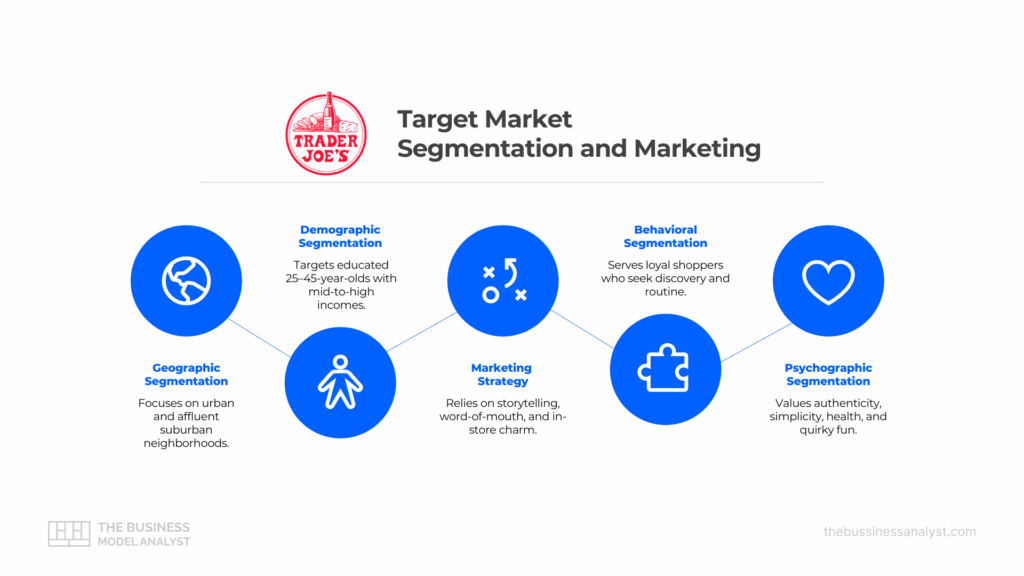
The Trader Joe’s target market is segmented across four key dimensions: demographics, geography, behavior, and psychographics. This segmentation shapes everything from product selection to store design and marketing tone.
For example, Trader Joe’s selects neighborhoods based on population density, education levels, and lifestyle indicators, ensuring its stores are placed in areas with high concentrations of its ideal shoppers. Within those communities, the brand uses friendly signage, humorous product labels, and product sampling to cater to behavior-based preferences like experimentation and social word-of-mouth.
Its marketing strategy is almost entirely grassroots—eschewing national advertising in favor of The Fearless Flyer, a newsletter that uses witty storytelling to promote products. This content is carefully crafted with psychographic traits in mind, appealing to consumers who value charm, wit, and authenticity.
In the following sections, we’ll explore each segmentation type in depth, starting with Demographic Segmentation.
Demographic Segmentation
Demographic segmentation focuses on attributes like age, gender, income, education, and occupation. Trader Joe’s uses this method effectively to attract and retain a core customer group that aligns with its distinct store identity and product offerings.
The typical Trader Joe’s shopper is between 25 and 45 years old, often college-educated, and employed in a professional or creative field. While the brand does not overtly target one gender, it tends to appeal more strongly to female consumers, who often make household grocery decisions. The store’s layout, product variety, and signage design are subtly curated to be approachable, quick to navigate, and slightly whimsical—appealing to busy, educated buyers who value both efficiency and charm.
Income level is another defining trait. Trader Joe’s attracts middle to upper-middle-class earners, typically in the $50,000–$100,000 annual income range. This allows the brand to position its private-label goods as “affordable premium”—less expensive than Whole Foods but with a higher perceived quality than conventional grocers. The store’s smaller footprint and curated inventory further support a sense of boutique accessibility rather than mass-market overwhelm.
For instance, consider a 33-year-old graphic designer in Denver who earns $75,000 per year. They prioritize healthy eating, are mindful of costs, and enjoy trying new snacks or wines. Trader Joe’s speaks directly to this demographic—offering organic produce, budget-friendly frozen meals, and unique seasonal items that feel personal and thoughtfully chosen.
Geographic Segmentation
Geographic segmentation divides consumers based on physical location—such as region, climate, or population density. Trader Joe’s carefully selects its store locations to align with the living habits and purchasing behaviors of its core audience, focusing heavily on urban and affluent suburban areas across the United States.
Trader Joe’s currently operates over 500 stores, primarily located in densely populated metropolitan areas. Cities like Los Angeles, New York, Chicago, and Seattle host multiple Trader Joe’s locations. The company often targets neighborhoods with a high concentration of young professionals, college-educated residents, and environmentally conscious shoppers. These traits correlate with higher interest in organic foods, specialty products, and ethical sourcing—key pillars of Trader Joe’s brand identity.
The brand does not follow a blanket national strategy. Instead, it adapts product offerings regionally, stocking items based on local preferences and seasonal demands. For instance, Southwestern stores may offer more chili-based sauces, while stores in coastal California feature an expanded selection of vegan and gluten-free products to match local dietary trends.
A real-world example is the opening of Trader Joe’s in Brooklyn’s Cobble Hill neighborhood. The store was positioned to attract the area’s mix of young families and professionals, offering curated selections like organic snacks, imported cheeses, and budget-friendly wine—all tailored to the urban, health-aware, time-conscious shopper.
Behavioral Segmentation
Behavioral segmentation categorizes consumers based on their habits, usage patterns, purchasing behavior, and decision-making processes. Trader Joe’s uses this approach to identify how, when, and why customers shop—then crafts experiences that foster loyalty, routine, and brand enthusiasm.
A defining behavior of the Trader Joe’s target market is frequent, small-basket shopping. Unlike big-box grocers, where shoppers stock up weekly, many Trader Joe’s customers visit multiple times a week for fresh meals, snacks, and impulse discoveries. This behavior is encouraged through a rotating inventory, limited-edition seasonal products, and friendly in-store sampling that turns routine errands into “treasure hunts.”
Another significant pattern is brand trust and loyalty. Trader Joe’s offers almost entirely private-label products, and customers have developed strong confidence in these offerings due to consistent quality and transparent labeling. This eliminates choice overload, a common pain point in larger grocery chains, and builds habitual loyalty. Many shoppers develop emotional bonds with specific products—like Everything But the Bagel Seasoning or Cauliflower Gnocchi—creating routines that drive repeat visits.
Word-of-mouth marketing is also deeply embedded in customer behavior. Trader Joe’s encourages organic sharing through engaging product stories and surprise finds that customers love to talk about. This informal buzz has effectively replaced traditional advertising. A 2022 CivicScience survey found that over 60% of Trader Joe’s shoppers rely on friend recommendations or social media chatter when trying new items.
In summary, Trader Joe’s shapes its business model around habitual behaviors—routine shopping, product experimentation, and social sharing—which create long-term emotional and financial value.
Psychographic Segmentation
Psychographic segmentation goes beyond demographics and behavior to explore consumers’ values, lifestyles, personalities, and emotional drivers. Trader Joe’s has built a brand identity that deeply aligns with the psychographic profile of its core audience—those who prioritize health, simplicity, ethical consumption, and discovery.
At its core, the Trader Joe’s target market is composed of shoppers who value authenticity over mass appeal. These consumers prefer brands that feel “human” and unpolished, which Trader Joe’s reinforces through its hand-drawn signage, casual tone, and friendly employees. This cultivates a shopping experience that feels more like a local co-op than a national chain.
Customers are typically adventurous eaters and value-seekers. They’re drawn to Trader Joe’s for the thrill of discovering new, quirky products—whether it’s ube spread or lentil pasta—and they enjoy sharing those discoveries with friends. Psychologically, this aligns with a desire for personal identity and self-expression through consumption. Buying something unique or ethically sourced becomes a form of social signaling.
Trader Joe’s also connects emotionally through its stance on environmental and social responsibility. Many of its core shoppers care about reducing plastic use, eating sustainably, and avoiding artificial additives. The store’s commitment to these principles is subtle yet consistent, appealing to conscious consumers who prefer doing good without self-congratulation.
An illustrative example is a health-conscious millennial in Seattle who shops at Trader Joe’s not just for groceries, but for peace of mind. They trust that the store aligns with their values—sustainability, ethical sourcing, and simplicity—without the elitism sometimes found in natural food markets.
Trader Joe’s Marketing Strategy
Trader Joe’s employs a minimalist, word-of-mouth-driven marketing strategy that sets it apart from conventional grocery chains. The brand does not rely on TV commercials, influencer partnerships, or paid digital ads. Instead, it fosters customer loyalty and brand buzz through organic experiences, in-store storytelling, and a deep understanding of its audience.
The cornerstone of its marketing is The Fearless Flyer, a monthly newsletter—both printed and online—that blends product promotion with entertaining, quirky storytelling. Written in a witty, accessible tone, it turns grocery descriptions into narratives, reflecting the playful personality of the Trader Joe’s brand.
Trader Joe’s also uses in-store experiences as a key promotional tool. From cheerful staff and tastings to chalkboard signage with hand-drawn art, every element reinforces the feeling of shopping at a local market run by friends rather than a national retailer.
On digital platforms, Trader Joe’s maintains an understated but effective presence. Its podcast, “Inside Trader Joe’s,” reveals behind-the-scenes stories, decisions, and product development insights—strengthening customer trust. The strategy centers not on pushing products but on inviting customers into the brand’s culture, which is precisely what its psychographically aligned audience desires.
How Trader Joe’s Reaches Its Audience
Trader Joe’s reaches its audience through a unique blend of experiential marketing, grassroots content, and in-store intimacy. These methods are tailored to reflect the values and preferences of its target market—particularly those who appreciate authenticity, discovery, and community-driven branding.
In-Store Experience
Every Trader Joe’s store functions as a tactile marketing channel. From hand-written chalk signs to themed displays and casual employee uniforms, the store feels more like a neighborhood market than a supermarket chain. Staff interactions are warm and conversational, reinforcing the brand’s identity as approachable and human-centered. Sampling stations and curated endcaps encourage spontaneous discovery—a key appeal to adventurous eaters.
The Fearless Flyer
The Fearless Flyer is Trader Joe’s most iconic and consistent marketing asset. Delivered both by mail and hosted online, it features witty copy, cartoon illustrations, and offbeat humor. Rather than simply listing deals, it tells stories about products, giving them personality and purpose. This format resonates deeply with Trader Joe’s audience, who enjoy reading it as much as using it as a shopping guide.
Word-of-Mouth and Social Media
Trader Joe’s customers act as brand ambassadors without being asked. Whether it’s through Instagram “haul” videos, Reddit fan discussions, or TikTok product reviews, customers organically promote new finds and seasonal favorites. The brand does not aggressively post or sponsor influencers—it lets the audience speak for it, capitalizing on loyalty and the thrill of discovery.
Podcast and Website Content
Trader Joe’s podcast, “Inside Trader Joe’s,” extends the brand experience beyond the store. Episodes discuss behind-the-scenes stories about sourcing, sustainability, and product creation. This transparency builds trust, giving fans more reasons to engage with the brand. The website complements this by offering recipes, product spotlights, and FAQs that cater to the health-conscious and curious.
Comparison to Competitors’ Target Audience
When comparing Trader Joe’s to its top competitors, Whole Foods Market and Aldi, distinct approaches to target audiences emerge. Each brand attracts loyal customers through unique value propositions, driven by differences in pricing, product range, and emotional positioning.
Trader Joe’s vs Whole Foods Market Target Audience
Both Trader Joe’s and Whole Foods serve health-conscious, quality-driven shoppers, but they differ significantly in price positioning and psychographic appeal. While Whole Foods—dubbed “Whole Paycheck”—caters to wealthier consumers focused on premium organic and sustainably sourced goods, Trader Joe’s delivers similar values at affordable price points. This makes Trader Joe’s more accessible to middle-income customers who desire natural products without the higher cost.
Demographically, Whole Foods draws slightly older consumers (30s–50s) with higher household incomes ($100k+), aligned with the Whole Foods mission and vision statement, while Trader Joe’s focuses more on younger professionals (25–45) seeking novelty and value. Psychographically, Whole Foods shoppers prioritize certification, exclusivity, and curated wellness, whereas Trader Joe’s customers emphasize discovery, humor, and community, reflected in its quirky branding and in-store personality.
Trader Joe’s vs Aldi Target Audience
Aldi and Trader Joe’s both appeal to budget-conscious consumers but through different emotional experiences. Aldi’s business model price-sensitive shoppers, including families and value-seekers who want the lowest cost per item. Its no-frills model and cost-savings approach resonate with practical-minded consumers focused purely on value.
In contrast, Trader Joe’s also targets value-seekers, but positions itself for those who want fun, uniqueness, and quality in their bargain. Trader Joe’s shoppers enjoy exploring curated offerings like international snacks or exclusive wines. They appreciate the experiential element—something Aldi deliberately minimizes.
Similarities in Target Audiences
There is overlap across all three brands in attracting consumers who value private-label products, low markup, and quality assurances. Trader Joe’s, Whole Foods, and Aldi appeal to people who want store brands they can trust and rely on. All three rely on some private label control to maintain price and sourcing oversight.
Key Differences in Target Audiences
Where they diverge is in emotional connection and shopping experience. Whole Foods prioritizes premium lifestyle appeal and attribute certification (organic, non-GMO). Aldi emphasizes efficiency and low cost, minimal choice, and rapid shopping. Trader Joe’s strikes a balance—delivering affordable quality with personality and novelty—which attracts consumers seeking both substance and surprise.
Trader Joe’s Advantages
- Brand Personality & Experience – Trader Joe’s humor‑driven branding, in‑store charm, and curated product rotation create an engaging environment that builds loyalty through discovery.
- Affordable Premium Positioning – By offering high-quality, private‑label goods at lower prices than Whole Foods, Trader Joe’s attracts quality‑conscious shoppers without premium pricing.
- Strong Word of Mouth – The Fearless Flyer, sampling stations, and social sharing generate organic buzz—making marketing a byproduct of the customer experience.
- Operational Efficiency & Freshness – Smaller store formats and tight inventory cycles enable fresher produce and faster adaptation to trends, giving it a nimble edge in value and novelty.
Trader Joe’s Disadvantages
- Limited Product Variety – Trader Joe’s smaller store size means fewer choices, which can frustrate shoppers seeking specialty items, bulk goods, or extensive selections.
- Underrepresentation in Rural Markets – With a focus on urban/suburban locales, Trader Joe’s lacks presence in smaller towns where Aldi or Walmart dominate.
- Perceived Lack of Certifications – Unlike Whole Foods, Trader Joe’s rarely emphasizes third‑party certifications (e.g., USDA Organic), which may deter certification‑driven shoppers.
- Dependency on Private Labels – While private labeling enables control and margin, Trader Joe’s misses brand-loyal customers who prefer specific national or trusted brands not carried in-store.
Conclusion
Trader Joe’s has carved out a distinctive niche in the grocery market by deeply understanding its target audience and aligning every element of the shopping experience to fit their values, behaviors, and expectations. Through smart segmentation—demographic, geographic, behavioral, and psychographic—the brand consistently delivers a curated, affordable, and emotionally resonant experience.
By targeting health-conscious, educated, and adventurous urban and suburban consumers, Trader Joe’s avoids mass-market competition and instead fosters a loyal community that sees the brand as an extension of their lifestyle. Its unique strategies—like avoiding traditional advertising, embracing a small-store format, and emphasizing storytelling—have allowed it to thrive without following industry norms.
However, as market dynamics evolve and competitors like Whole Foods and Aldi expand their reach and adapt pricing or sourcing strategies, Trader Joe’s will need to remain agile. Expanding product variety, emphasizing sustainability credentials, or reaching into underserved geographic markets could help sustain growth while remaining true to its brand identity.
Ultimately, the Trader Joe’s target market isn’t just a demographic—it’s a mindset. And Trader Joe’s success lies in continuously tapping into that mindset with simplicity, authenticity, and charm.


