
Doordash Target Market Analysis
Jul
Understanding a company’s target market is essential for sustained growth and effective marketing. A well-defined target audience allows brands to create relevant messaging, tailor product offerings, and prioritize customer satisfaction. For businesses operating in fast-paced, digital-first industries, this insight is especially critical — and few sectors illustrate this better than food delivery.
DoorDash, a leading on-demand delivery service, has become a household name in the United States and several international markets. Since its launch in 2013, the company has evolved from a simple delivery app to a logistics platform serving restaurants, convenience stores, and even grocery retailers. Its ability to scale while maintaining user engagement has made it a top competitor in the gig economy and food tech space.
This article provides a deep dive into the DoorDash target market, exploring who uses the service, why they use it, and how DoorDash segments and engages these groups. We’ll examine its customer demographics, behaviors, values, and geographic reach. In addition, we’ll contrast its audience with those of major competitors like Uber Eats and Grubhub, highlighting DoorDash’s unique advantages and challenges.
Contents
Who is DoorDash’s Target Audience?
The DoorDash target market is primarily composed of digitally savvy consumers who prioritize convenience, time savings, and flexible options in their food and grocery choices. The company serves a wide demographic, but its strongest foothold lies among urban and suburban consumers aged 18 to 44. These individuals are comfortable with mobile apps, often have demanding schedules, and are willing to pay a premium for delivery convenience.
Millennials and Gen Z make up a significant portion of DoorDash users. These age groups tend to value speed, digital efficiency, and on-demand access to services. They are also more likely to use multiple delivery apps and compare options based on delivery fees, promotions, and wait times. For example, DoorDash’s DashPass subscription — which offers reduced fees and exclusive deals — appeals to frequent users, especially younger professionals or students.
Income levels among DoorDash’s core users vary. While the platform attracts high-earning urbanites who can afford frequent orders, it also caters to middle-income households, particularly those juggling work and family responsibilities. This flexibility is part of DoorDash’s broader appeal. With tiered pricing, occasional discounts, and partnerships with fast food chains, the brand successfully draws both budget-conscious and convenience-driven consumers.
DoorDash also sees strong engagement from dual-income households and young families who use the service to simplify mealtime. In addition, the platform appeals to those who prioritize variety and access to local cuisine — often offering delivery from restaurants that don’t traditionally deliver on their own. This aligns with lifestyle values such as supporting local businesses and exploring new food experiences without leaving home.
DoorDash Target Market Segmentation and Marketing
Market segmentation is the process of dividing a broad consumer base into smaller groups based on shared characteristics. These segments help companies tailor their messaging, services, and promotions to meet specific needs more effectively. DoorDash relies heavily on segmentation to refine its product offerings and marketing strategies across different user types.
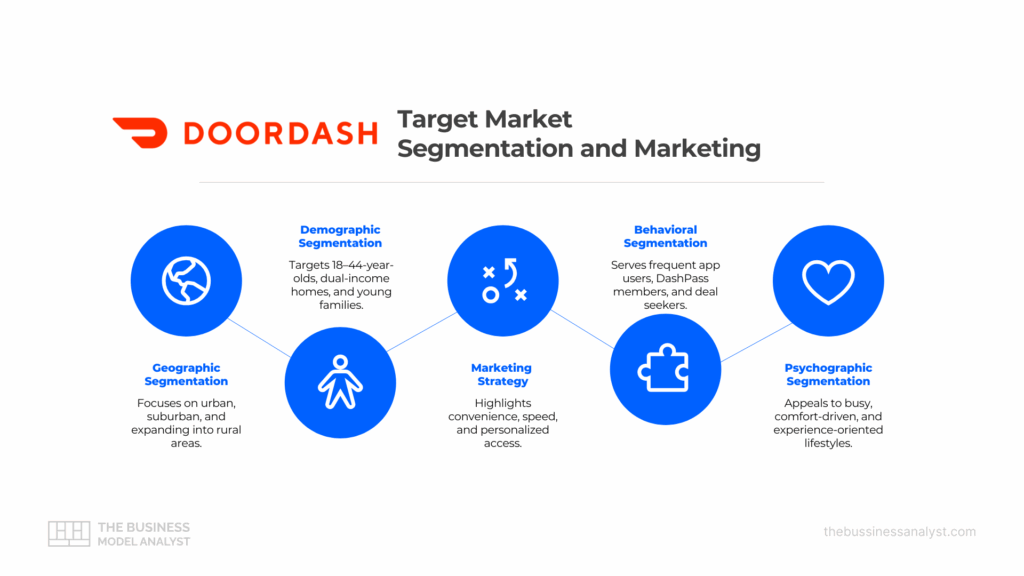
The DoorDash target market is segmented across four key dimensions: demographic, geographic, behavioral, and psychographic. Each plays a critical role in shaping how DoorDash engages customers, from casual users to loyal subscribers.
For example, the company may promote convenience and family meal bundles to suburban families while targeting young professionals in cities with speedy lunch deliveries from nearby restaurants. Its app design and campaign messaging vary based on data insights gathered from user behavior, location, and preferences.
In the following subsections, we’ll explore how DoorDash uses each of these segmentation types to connect with distinct audience segments and drive user engagement.
Demographic Segmentation
Demographic segmentation focuses on characteristics such as age, gender, income, education level, and household status. For DoorDash, this type of segmentation is crucial in understanding who its core users are and how to craft services that resonate with their day-to-day lives.
Age is one of the most defining traits in the DoorDash target market. The platform heavily appeals to users aged 18 to 44, particularly Millennials and Gen Z, who are digital natives. These consumers grew up with smartphones and are comfortable using apps for everyday tasks. DoorDash’s intuitive user interface, integration with mobile wallets, and personalized recommendations are all optimized for this tech-savvy demographic.
Gender plays a more subtle role. While both men and women use DoorDash, research suggests women — particularly working mothers and female heads of household — tend to order food delivery more often during the week. DoorDash tailors marketing messaging to this group by highlighting family-sized deals, grocery delivery for busy days, and promotions tied to meal planning.
When it comes to income levels, DoorDash appeals to a mix of middle- and upper-income brackets. While lower-income users might be price-sensitive, DoorDash uses limited-time offers, low-fee fast food options, and subscription models like DashPass to make delivery more accessible. At the same time, higher earners in urban areas are drawn to convenience, time savings, and access to premium restaurant options.
Education level also factors in. Many users are college-educated professionals, balancing work and personal obligations. DoorDash often markets toward this group with productivity-oriented language like “skip the grocery line” or “save time, stay focused.”
A typical customer persona might be a 30-year-old urban professional with a college degree, living in a dual-income household, and placing food orders three to four times a week to save time. This demographic data guides how DoorDash structures promotions, app notifications, and even partnerships with restaurant chains.
Geographic Segmentation
Geographic segmentation categorizes consumers based on their physical location. For DoorDash, geography plays a vital role in service availability, delivery logistics, and localized marketing strategies. The company operates in over 7,000 cities across the United States, Canada, Australia, and Japan, adapting its offerings to match each region’s habits and preferences.
In the U.S., DoorDash holds a dominant market share in major metropolitan areas like Los Angeles, New York City, and Chicago, but it also thrives in suburban regions where traditional food delivery has been limited. By targeting suburbs with fewer local delivery options, DoorDash tapped into an underserved market — especially during the COVID-19 pandemic, when suburban food delivery demand surged.
Rural areas, though more challenging due to lower population density, are not ignored. DoorDash has experimented with “project DASH”, which leverages local drivers to help community organizations and non-profits with food distribution, subtly introducing the brand in smaller towns while building goodwill.
Internationally, DoorDash has tailored its platform to local culinary cultures. In Canada, for example, it emphasizes partnerships with popular chains like Tim Hortons, while in Australia, it adapts pricing models and delivery hours based on local dining patterns.
The app uses location-based features like real-time restaurant availability and hyperlocal promotions, ensuring relevance in every market. For instance, users in Miami might see deals from Cuban restaurants, while those in Seattle are offered discounts at poke bowl shops — a clear reflection of how geographic segmentation shapes customer engagement.
Behavioral Segmentation
Behavioral segmentation analyzes how customers interact with a product or service — from purchase habits and frequency of use to loyalty and responsiveness to promotions. For DoorDash, understanding user behavior is central to shaping its app experience and marketing strategies.
One key behavior among the DoorDash target market is usage frequency. Some users order once a month, while others — often city dwellers or busy professionals — place multiple orders weekly. DoorDash identifies these high-frequency users and targets them with DashPass, its subscription service offering free delivery and exclusive discounts. This strategy incentivizes loyalty and increases order volume over time.
DoorDash also segments users based on order preferences. For example, late-night snackers may receive promotions for 24/7 restaurants, while lunchtime users are shown fast, affordable options near office districts. This personalization is powered by behavioral data like order time, cuisine type, and delivery location.
Another vital behavior is response to promotions. DoorDash routinely tests discount sensitivity, sending $5-off or free-delivery offers to encourage lapsed users to return. If a customer stops using the app, DoorDash may trigger re-engagement emails or push notifications — often customized by past ordering behavior.
Additionally, the platform tracks user feedback and ratings, using this data to improve restaurant recommendations and enhance customer experience. High ratings for a certain restaurant can elevate its placement in search results, nudging future choices and reinforcing habits.
DoorDash also monitors behavior to drive upselling. A user ordering tacos might be shown relevant add-ons like chips and salsa or desserts from nearby vendors. These behavioral nudges are designed to increase average order value without disrupting the user journey.
Psychographic Segmentation
Psychographic segmentation goes beyond demographics and behaviors to understand the values, lifestyle, personality, and emotional motivations behind consumer choices. For DoorDash, this segmentation reveals why people choose delivery — not just who they are or how often they order.
A key driver for many in the DoorDash target market is the value placed on convenience and control. Users appreciate the ability to eat what they want, when they want, without leaving home. This emotional appeal — centered on comfort, autonomy, and saving time — is especially strong among young professionals, busy parents, and students balancing packed schedules.
Another common psychographic trait is a desire for experiential variety. Many DoorDash users see food delivery not just as a service, but as a small indulgence or a form of entertainment. By offering everything from fast food to artisanal dishes, DoorDash taps into consumers who treat meals as personal rewards or social experiences. Promotions often frame delivery as a “night in,” “cheat day,” or “break from cooking,” reinforcing this mindset.
Values like supporting local businesses also influence ordering decisions. DoorDash strategically partners with independent restaurants and promotes them through in-app banners or “local favorites” sections. This appeals to consumers who prioritize community impact, especially post-pandemic.
DoorDash’s messaging often uses a tone of empowerment and personalization. Phrases like “your cravings delivered” and “your way, anytime” speak to a culture that celebrates customization and instant gratification — key lifestyle traits of its core audience.
This psychographic insight allows DoorDash to build stronger emotional connections with users, making their brand feel less like a utility and more like a lifestyle enhancer.
DoorDash Marketing Strategy
DoorDash uses a multi-channel marketing strategy to reach and retain its diverse audience. It relies heavily on digital advertising, influencer partnerships, app-based promotions, and targeted social media campaigns to attract both new and returning users.
The brand’s core messaging emphasizes convenience, choice, and speed. Whether through app notifications like “Order now and get it in 25 minutes” or ads showing busy professionals relaxing while their food arrives, DoorDash frames itself as a time-saving solution to everyday challenges. This emotional appeal is central to its marketing voice — efficient, friendly, and empowering.
To stay competitive, DoorDash invests in seasonal promotions, co-branded campaigns with fast-food giants like McDonald’s or Taco Bell, and localized outreach to highlight regional favorites. On platforms like Instagram and TikTok, influencers share real-time delivery experiences, reinforcing the brand’s presence among younger, trend-aware audiences.
Meanwhile, loyalty programs like DashPass and personalized push alerts keep engagement high. Each tactic reflects a precise understanding of what resonates with different segments of the DoorDash target market — from students looking for deals to families seeking dinner solutions.
How DoorDash Reaches Its Audience
DoorDash engages users through a variety of targeted approaches, each tailored to specific segments and behaviors. Below are key methods it uses to connect with different audience groups:
App-Based Personalization
The DoorDash app is the central hub for personalization. It presents users with customized restaurant and promo suggestions based on past orders, time of day, and location. For instance, college students might see late-night snack options, while working professionals get lunch-time deals. Personalization boosts user satisfaction and repeat orders.
Push Notifications & Email Campaigns
By analyzing behavior, DoorDash sends strategic alerts to re-engage lapsed users or encourage upsells. Notifications like “Your favorite burger joint is giving you 20% off” play on familiarity. Email campaigns targeted at DashPass members highlight exclusive perks, reinforcing loyalty and maximizing lifetime value.
Influencer & Social Media Collaborations
DoorDash partners with food and lifestyle influencers to reach younger demographics and boost brand visibility. On platforms like TikTok and Instagram, creators share meal reveal videos, “What I ordered” clips, or unboxing deliveries—helping to normalize and glamorize ordering. These grassroots tactics feel authentic and drive app downloads and trial.
Local & Co-Branded Promotions
Partnerships with national franchises (e.g., Subway, McDonald’s) and local favorites enable DoorDash to offer compelling deals. In select cities, it runs co-branded marketing campaigns—like college campus activations, restaurant pop-ups, or sponsored events—helping target regional preferences and build deeper engagement within local communities.
Comparison to Competitors’ Target Audience
Below is a detailed analysis of how DoorDash’s audience compares with its primary competitors: Uber Eats and Grubhub.
DoorDash vs Uber Eats Target Audience
Both DoorDash and Uber Eats attract urban, tech‑savvy consumers in the 18–44 age range. However, Uber Eats skews slightly younger and urban‑centered, often capturing late‑night and convenience‑driven orders in major metro areas. DoorDash, by contrast, has more suburban and family appeal, thanks to its strong integration of grocery and convenience store delivery. Although both services offer subscriptions (DashPass vs Uber One), DoorDash’s tiered value packages and local business emphasis gives it broader appeal across income levels.
DoorDash vs Grubhub Target Audience
Grubhub tends to draw slightly older, mid‑income families in dense urban neighborhoods with a high concentration of traditional restaurants. This demographic values variety and established brands. DoorDash, meanwhile, reaches across urban and suburban zones with a mix of fast food, grocers, and independent eateries. Whereas Grubhub emphasizes restaurant partnerships, DoorDash’s strategy focuses on a wider ecosystem — groceries, convenience, and local delivery — appealing to both families and younger users.
Similarities in Target Audiences
Both DoorDash and its main rivals—Uber Eats and Grubhub—target digitally fluent adults aged 18–44, primarily living in urban and suburban areas. All platforms emphasize convenience, app experience, and access to diverse food options. Additionally, subscription services and promotional offers are common strategies across the board.
Key Differences in Target Audiences
DoorDash differentiates itself through stronger suburb and grocery market penetration, while Uber Eats remains urban and late‑night focused. Grubhub maintains deeper roots in older urban customers loyal to local restaurants. DoorDash’s multi‑offer ecosystem appeals broadly, creating a wider consumer base, albeit sometimes with diluted luxury or gourmet positioning compared to competitors focused on premium offerings.
DoorDash Advantages
- Suburban & Grocery Penetration
DoorDash’s seamless integration of grocery and convenience deliveries, alongside traditional restaurant service, makes it a one‑stop shop for users outside major cities. This breadth attracts a wider audience and increases order frequency. - DashPass Loyalty & Value
The growth of DashPass highlights how effective subscription bundles can drive loyalty. DashPass users engage more frequently and show higher lifetime value than non‑subscribers. - Local Business Partnerships
Active promotion of independent restaurants and local chains strengthens community ties. This positioning appeals to consumers who want to support local economies—a value Uber Eats and Grubhub emphasize less. - App Personalization Engine
DoorDash’s recommendation system adapts by cuisine, time, and order history, creating a more customized experience. This engine fuels repeat usage and upselling opportunities.
DoorDash Disadvantages
- Subscription Complexity
With tiered DashPass offerings and variable fee waivers, the subscription model can be confusing to some users. Uber One, with a single flat fee, offers a simpler alternative. - Quality Control Across Categories
As DoorDash branches into groceries and convenience, it faces operational complexity that can affect delivery consistency. Specialized services like Prime Now (Amazon) or Uber Eats focus on fewer categories, enabling tighter quality control. - Urban Late‑Night Presence
Uber Eats often dominates late‑night orders in dense city centers, a segment where DoorDash is still gaining ground. - Premium Dining Appeal
Grubhub’s strength in premium or upscale local dining gives it an edge among foodies and diners seeking high‑end restaurant delivery, a niche DoorDash has been slower to prioritize.
Conclusion
A clear understanding of the DoorDash target market reveals why the platform remains a dominant force in the food delivery landscape. Its audience — a mix of tech-savvy Millennials, busy professionals, families, and value-conscious consumers — values speed, variety, and personalized convenience. By tailoring services through demographic, geographic, behavioral, and psychographic segmentation, DoorDash adapts to evolving customer needs.
Compared to Uber Eats and Grubhub, DoorDash stands out for its suburban reach, diversified offerings, and local restaurant support. Its strengths in personalization and loyalty programs further deepen customer engagement. However, the company must continue refining its service quality and subscription clarity to stay ahead in a highly competitive market.
As consumer expectations rise and digital ecosystems expand, DoorDash’s future success will depend on how well it continues to evolve its understanding of the market. A data-driven, emotionally intelligent approach to segmentation will be key to sustaining its lead — and redefining how we access food and convenience services.


