
H&M Target Market Analysis
Jul
Understanding a company’s target market is essential for building effective marketing strategies, designing appealing products, and cultivating lasting brand loyalty. For global fashion retailers like H&M, knowing exactly who their customers are—and what motivates them—is what keeps the brand relevant in a fast-changing industry.
H&M, short for Hennes & Mauritz, is a Swedish multinational fashion retailer known for offering affordable, trend-driven clothing and accessories. With thousands of stores worldwide and a growing e-commerce presence, H&M stands as one of the largest fashion retailers globally. Its model of fast fashion relies on quickly adapting runway trends into accessible products for the mass market.
This article presents an in-depth H&M target market analysis. We’ll explore who H&M’s ideal customers are, how the brand segments its market, and what strategies it uses to reach and engage those audiences. By examining demographics, geography, behavior, and psychographics, we’ll uncover the tactics that help H&M remain a dominant player in the competitive fashion retail space. Comparisons to key competitors like Zara and Uniqlo will also highlight the brand’s unique positioning and strategic strengths.
Contents
Who is H&M’s Target Audience?
The H&M target market primarily consists of fashion-conscious individuals aged 18 to 35, spanning both women and men, though the brand leans more heavily into women’s fashion. These customers are typically urban, digitally connected, and value-driven. They seek stylish, on-trend clothing at accessible price points, making H&M’s affordability a key attraction.
Most of H&M’s core audience falls within the middle-income bracket, often comprising college students, young professionals, and early-career workers. They’re drawn to H&M not just for its prices but for its ability to mimic luxury and runway styles quickly and affordably. This audience values variety, convenience, and social relevance, expecting new styles to be available regularly, both in stores and online.
An important aspect of H&M’s appeal is its alignment with socially conscious values. Many younger customers care deeply about sustainability and ethical production. H&M has responded with initiatives like its Conscious Collection, clothing recycling programs, and transparent sustainability goals. These efforts resonate strongly with Millennial and Gen Z shoppers, who often weigh ethical considerations when making purchases.
Behavioral data backs this up. For example, H&M’s mobile app and online store usage trends show high activity during seasonal drops and exclusive collection launches, such as past collaborations with designers like Balmain or Simone Rocha. These events draw heavy interest from fashion-forward audiences eager for designer styles at a fraction of the cost.
Overall, the H&M target market includes style-savvy, value-oriented, and socially aware individuals who prioritize both trendiness and accessibility in their fashion choices.
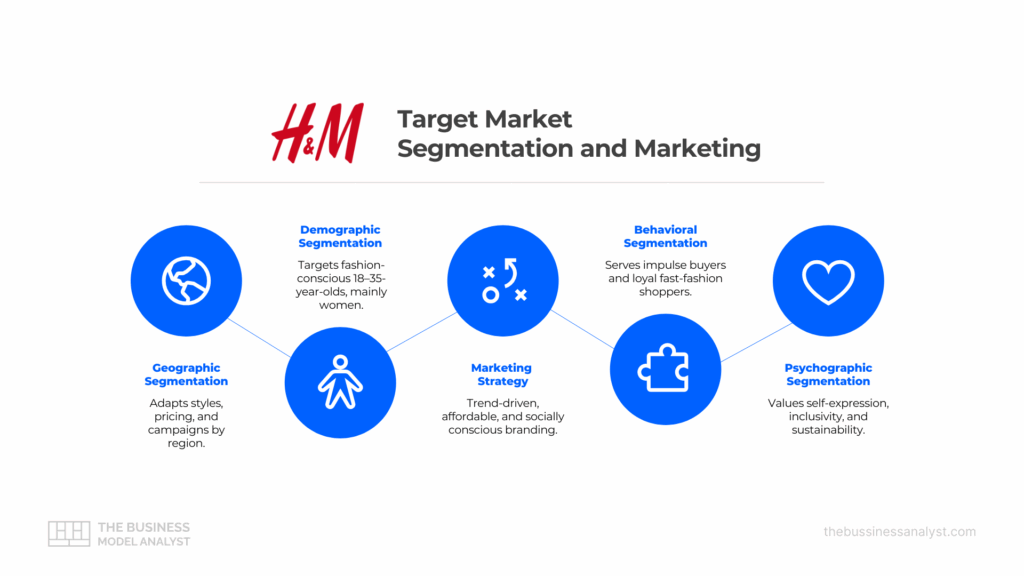
H&M Target Market Segmentation and Marketing
Market segmentation involves dividing a broad customer base into smaller, more manageable groups based on shared characteristics. By understanding these groups, companies like H&M can craft personalized marketing strategies, improve product relevance, and enhance customer loyalty.
H&M applies market segmentation to reach diverse global audiences effectively. With a presence in more than 70 markets, the brand must tailor its message to resonate with local tastes while maintaining a cohesive global identity. It accomplishes this through a combination of data-driven insights and creative localization.
H&M uses four main segmentation strategies: demographic, geographic, behavioral, and psychographic. Each of these plays a vital role in how H&M identifies its ideal customers and delivers personalized value. From tailoring product lines by region to designing campaigns around lifestyle aspirations, these segmentation models help H&M stay competitive and relevant.
In the following sections, we’ll explore how H&M applies each type of segmentation in detail to better understand the core strategies behind its marketing success.
Demographic Segmentation
Demographic segmentation refers to dividing a market based on measurable characteristics like age, gender, income, and education level. For H&M, this form of segmentation is especially critical, as the brand serves a vast and varied customer base.
The primary demographic for H&M includes individuals aged 18 to 35, skewing slightly toward women. This group is often in the midst of major life transitions—college, first jobs, or early career moves—and seeks fashion that balances affordability with a sense of individuality. H&M’s product lines reflect this: casual basics, business-casual wear, party outfits, and streetwear styles all coexist in its collections.
Income level plays a significant role in this demographic’s buying behavior. H&M targets middle-income consumers who want fashionable, high-turnover wardrobe options without the high cost. For this audience, price sensitivity is high, but so is the desire to keep up with trends. H&M capitalizes on this by delivering fashion-forward designs at relatively low prices.
Gender segmentation also factors into H&M’s strategy. While the brand sells clothing for all genders and ages—including children and men—the women’s section receives the most attention in marketing and product variety. However, H&M has expanded its offerings for men, especially with the rise of men’s fashion on social media and influencer platforms.
Education indirectly influences this group’s shopping habits. Many of H&M’s core customers are either in school or have recently graduated. This often translates to a desire for fashionable clothing that fits both campus and casual professional environments, a niche H&M fills with its diverse, versatile clothing lines.
Campaigns like H&M’s collaborations with designers—Versace (2011), Balmain (2015), and Mugler (2023)—have also appealed to this demographic. These drops create aspirational excitement around fashion accessibility and often sell out quickly, showcasing how H&M understands its audience’s values and budget constraints.
Geographic Segmentation
Geographic segmentation involves dividing a market based on location—such as country, region, climate, or city size. H&M’s global scale makes this strategy essential, as customer preferences can vary widely from Stockholm to Shanghai.
H&M operates in over 70 countries, with strong presences in Europe, North America, and increasingly in Asia and the Middle East. While its largest market is Germany, the brand has also built substantial followings in the United States, United Kingdom, India, China, and Japan. Each market demands different styles, pricing strategies, and product availability based on local culture and climate.
For example, H&M offers modest fashion lines in countries like the United Arab Emirates and Indonesia, reflecting local customs and religious values. In colder climates like Scandinavia and Canada, the brand promotes outerwear collections that cater to winter-specific needs, while in warmer regions, lighter, breathable fabrics take precedence.
Localization extends to marketing as well. H&M uses region-specific advertising campaigns, languages, and influencers to engage local audiences. For instance, its marketing in India includes regional languages and culturally relevant campaigns that focus on festivities like Diwali. In Japan, minimalist style trends are reflected in more pared-down product displays and ad visuals.
H&M also adapts pricing. In markets with lower average incomes, the brand may emphasize basic lines or launch local promotions to stay competitive. These adjustments allow H&M to remain accessible and culturally relevant—no matter where its customers live.
Behavioral Segmentation
Behavioral segmentation divides a market based on consumer actions—such as buying habits, usage frequency, brand loyalty, and response to marketing. For H&M, understanding these behaviors is key to keeping pace with the fast-moving fashion industry and digital retail environment.
H&M’s target audience frequently engages in trend-driven, impulse buying. These shoppers are often influenced by seasonal styles, influencer endorsements, or limited-time collections. H&M leverages this by frequently updating inventory and promoting “drop culture” events, where new items are released rapidly to create urgency and excitement. Collections like the 2023 Mugler x H&M collaboration drew long lines and sold out in hours, proving the power of exclusivity and brand loyalty.
The company also segments customers based on shopping platform preference. With a growing number of users shopping via the H&M app and website, the brand uses behavioral data—such as browsing history, cart abandonment, and purchase frequency—to deliver personalized promotions. Tailored push notifications and targeted discounts encourage return visits and conversion.
Loyalty behavior is another crucial factor. H&M’s “Hello Member” program rewards repeat purchases with discounts, early access to sales, and exclusive offers. This loyalty system fosters a sense of belonging, particularly among young customers who appreciate recognition and benefits in return for brand engagement.
Additionally, H&M monitors returns, product reviews, and wishlist activity to fine-tune both its online experience and product assortment. If a certain item sees high interest but frequent returns, it signals potential fit or quality issues that can be corrected in future lines. Such data-driven responsiveness strengthens customer trust and long-term retention.
By interpreting behavior, H&M ensures that its fashion offerings and user experience align with how modern consumers shop—not just what they buy.
Psychographic Segmentation
Psychographic segmentation focuses on values, lifestyles, personality traits, and beliefs—factors that explain why customers make decisions, not just who they are. For H&M, this segmentation is essential in creating emotional connections and aligning the brand with consumers’ identities and aspirations.
H&M’s core audience values self-expression, individuality, and inclusivity. These consumers, mostly Millennials and Gen Z, are drawn to brands that reflect their personal identity and evolving fashion sense. H&M responds by offering diverse styles—from minimalist basics to bold, avant-garde pieces—catering to a wide spectrum of tastes within one brand umbrella.
Sustainability and ethics are strong emotional drivers. This audience prefers brands that show environmental and social responsibility. In response, H&M launched its Conscious Collection, featuring clothes made from recycled or sustainably sourced materials. Campaigns emphasize transparency and eco-progress, aligning with the values of customers who want to shop with a clear conscience.
H&M also targets customers who value accessibility over elitism. Its collaborations with high-end designers like Maison Margiela or Giambattista Valli allow everyday shoppers to access luxury aesthetics without luxury prices. This strategy not only fuels aspiration but also creates a sense of inclusion and empowerment, key themes in psychographic loyalty.
Lifestyle plays a major role. H&M’s audience is often active on social media, open to trends, and interested in global culture. They respond well to campaigns that reflect diversity in race, body type, and gender expression. For example, the brand’s advertising regularly features models from varied backgrounds and non-traditional beauty standards, reinforcing its commitment to representation and modern values.
Through psychographic segmentation, H&M ensures that its brand not only sells fashion—but stands for something meaningful to the people who wear it.
H&M Marketing Strategy
H&M’s marketing strategy is built around accessibility, trend appeal, and social consciousness, designed to resonate with a globally diverse yet value-conscious audience. The brand uses a multi-channel approach, combining traditional advertising with strong digital and influencer marketing, echoing elements seen in Amazon’s marketing strategy that leverages platform personalization and global scale.
Social media plays a central role. H&M maintains active profiles on Instagram, TikTok, and YouTube, platforms where its core customers spend the most time. These channels highlight new collections, sustainability initiatives, and behind-the-scenes content, often featuring influencers or stylists to build authenticity.
H&M also invests in high-visibility campaigns for designer collaborations and seasonal launches. These are supported by global ads, digital countdowns, and influencer seeding, creating hype and urgency. At the same time, the brand’s in-store visuals and window displays are kept minimalist yet trend-forward, reinforcing its fast-fashion identity.
The company’s core message balances style and responsibility, reflected in taglines like “Look good, do good” or “Fashion and quality at the best price.” This mix of aspirational and ethical branding appeals directly to Gen Z and Millennial consumers.
How H&M Reaches Its Audience
H&M employs a multi-faceted communication approach tailored to reach various segments of its audience effectively. This includes leveraging digital platforms, physical retail, influencer partnerships, and sustainable storytelling. Each channel supports different customer behaviors and preferences, ensuring broad engagement without losing personalization.
Digital and Mobile Platforms
H&M’s website and mobile app are critical for reaching digitally native shoppers. With features like personalized recommendations, mobile-exclusive offers, and easy returns, the app enhances convenience and encourages frequent engagement. Push notifications are customized based on user behavior, making each touchpoint feel more relevant.
H&M also uses email marketing to promote flash sales, new collections, and member-exclusive rewards. These emails often reflect browsing or purchase history, reinforcing behavioral segmentation strategies.
Social Media and Influencer Marketing
H&M’s presence on platforms like Instagram, TikTok, and Pinterest targets younger users through a mix of editorial-style photography, short-form videos, and real-time trends. Collaborations with influencers—especially micro-influencers—add authenticity. Campaigns like #HMxMe invite users to share their own outfits, boosting organic visibility and community participation.
Notably, H&M has also worked with global celebrities like Beyoncé and The Weeknd, which helps bridge aspirational branding with mass-market appeal.
In-Store Experiences
Despite digital growth, physical retail remains essential. H&M stores are strategically placed in urban shopping hubs and malls, where foot traffic is highest. In-store experiences include curated sections for seasonal or sustainable collections, interactive mirrors, and localized product selections based on geographic preferences.
The stores also function as pick-up points for online orders, blending the convenience of e-commerce with immediate access and returns—something younger shoppers appreciate.
Sustainability and Transparency Initiatives
H&M reaches eco-conscious consumers through its sustainability messaging. Through content hubs like H&M Conscious, the brand educates customers on eco-friendly fabrics, recycling initiatives, and progress reports. QR codes on product tags provide transparency about materials and sourcing, reinforcing trust among skeptical shoppers.
By connecting through both emotional and practical channels, H&M reaches its audience not only where they are—but also in ways that align with their values and lifestyle habits.
Comparison to Competitors’ Target Audience
Below, we compare H&M’s target market to two of its strongest global competitors: Zara and Uniqlo. These comparisons reveal important insights about each brand’s audience, positioning, and strategic focus.
H&M vs Zara Target Audience
H&M and Zara both target fashion-aware individuals aged roughly 18–35, but their core approaches differ. Zara’s audience is slightly higher-income and more willing to pay a premium—Zara’s pricing and faster runway-to-store model signal to shoppers that they are buying near-luxury fashion. In contrast, H&M leans into value-first appeal, drawing younger or more cost-conscious customers.
Psychographically, Zara shoppers prioritize exclusivity and immediacy, desiring the latest runway trends delivered with minimal delay. H&M, meanwhile, focuses on inclusivity and variety, offering frequent style refreshes and broader segmentation in terms of gender, size, and cultural representation. While H&M highlights accessibility—e.g., designer collaborations at attainable prices—Zara cultivates an upscale-fast-fashion vibe.
Geographically, both brands have strong presences in urban centers worldwide. However, Zara’s relatively higher pricing positions it more firmly among urban professionals and fashion-savvy shoppers, whereas H&M’s slightly lower price points expand its reach into the student and early-career demographic.
H&M vs Uniqlo Target Audience
Uniqlo attracts a demographic similar in age, but more heavily emphasizes functionality, minimalism, and quality. Core customers value long-lasting wardrobe basics rather than rapid trend cycles. This contrasts with H&M’s audience, which favors frequent wardrobe updates.
In terms of psychographics, Uniqlo appeals to more practical shoppers who prioritize clean design, comfort, and neutral styling over bold statements. H&M’s audience, conversely, includes a significant subset that wants statement pieces and trend experimentation.
Behaviorally, Uniqlo customers tend to make larger, less frequent purchases with a focus on staple items, while H&M shoppers often engage in higher-frequency, smaller basket buys tied to fast fashion drops.
Similarities in Target Audiences
Across all three brands—H&M, Zara, and Uniqlo—customers tend to be urban, digitally active, and socially conscious. They are millennials and Gen Zers who appreciate accessibility in price and channels, value sustainability, and shop online regularly. The shared emphasis on basic items, seasonal updates, and social media presence reflects overlapping consumer demands.
Key Differences in Target Audiences
Despite audience overlap, each brand addresses distinct shopper expectations. Zara attracts those seeking the latest runway-inspired pieces, while H&M appeals to customers wanting style variety and value. Uniqlo appeals to pragmatic buyers focused on durability and timeless design.
Emotionally, H&M’s audience connects with fashion for all, including limited-edition collaborations and casual wear. Zara’s base seeks fashion-forward prestige, and Uniqlo’s shoppers resonate with quiet confidence and reliability.
H&M Advantages
- Brand Adaptability: H&M’s flexible product strategy—ranging from basics to high-fashion collaborations—allows it to serve diverse customer tastes. This adaptability helps the brand retain trendy shoppers without alienating more conservative buyers.
- Global Flagship Accessibility: With lower average price points and widespread global presence in over 70 countries, H&M is more affordable and geographically reachable than Zara, especially in emerging markets.
- Engaged Sustainability Messaging: H&M’s Conscious Collection and transparent initiatives resonate with young, eco-aware consumers. This ongoing narrative enhances both brand loyalty and modern relevance.
- Digital-Physical Integration: H&M’s strong e‑commerce platform, app personalization, and in-store service integration create a seamless shopping experience, meeting the expectations of digitally native shoppers.
H&M Disadvantages
- Perception of Fast-Fashion Wastefulness: Despite sustainability efforts, H&M still faces criticism for fast-fashion waste—an area where brands like Uniqlo (with focus on durability) receive fewer ethical critiques.
- Price Competition from Fast-Fashion Rivals: Ultra-low cost retailers (e.g., Shein, Primark) undercut H&M on price, attracting the most price-sensitive buyers and pressuring H&M to maintain low prices at scale.
- Trend Volatility Risk: Rapid collection cycles rely heavily on forecasting accuracy. Missed trends or overproduction can result in markdowns, returns, and inventory inefficiency.
- Inconsistent Brand Messaging: Juggling designer collaborations, basics, and sustainability can create brand confusion. Customers looking for cohesive identity may be unsure of whether H&M stands for trend, timelessness, or eco-friendliness.
Conclusion
H&M’s ability to understand and connect with its diverse target market is central to its global success. By segmenting audiences demographically, geographically, behaviorally, and psychographically, the brand tailors its messaging, product offerings, and digital experiences to match evolving consumer needs.
The H&M target market—primarily young, style-conscious, and value-driven individuals—responds well to the brand’s fast fashion model, sustainable messaging, and inclusive approach. While competition from Zara, Uniqlo, and ultra-low-cost brands is intense, H&M’s adaptability and global reach keep it relevant.
As fashion retail continues to shift toward personalization, sustainability, and digital convenience, H&M will need to refine its strategies while staying true to its brand values. A deeper investment in quality and transparency may further boost customer trust, while sharper trend execution could help maintain competitive edge in a crowded market.
Understanding and evolving with its target audience will remain H&M’s most valuable asset—one that defines not only its marketing success, but also its long-term brand identity.


