
Binance Target Market Analysis
Jul
Understanding your target market is essential for any business to flourish—and Binance is no exception. As one of the world’s leading cryptocurrency exchanges, Binance’s growth heavily depends on identifying and serving the right users. The Binance target market encompasses a diverse global audience, from crypto novices curious about digital assets to institutional investors seeking secure trading tools.
This analysis will explore who comprises Binance’s ideal customers, how the company segments and understands them, and what marketing strategies best resonate. We’ll examine Binance’s demographic, geographic, behavioral, and psychographic approach. Later, we’ll compare Binance’s audience profile to competing exchanges and highlight its strategic advantages and challenges.
By the end, you’ll gain a clear view of the Binance target market, how Binance aligns its messaging and offerings to serve them, and where it stands relative to competitors. Understanding this will help marketers, investors, and crypto enthusiasts grasp why Binance is uniquely positioned—and where it still faces hurdles.
Contents
Who is Binance’s Target Audience?
The Binance target market spans a broad yet specific segment of the global population: primarily tech-savvy individuals aged 20 to 45, typically male, with a strong interest in finance, investing, and cryptocurrency. These users often reside in emerging markets or countries with active crypto regulations, and they’re drawn to Binance’s fast transaction speeds, low trading fees, and expansive token offerings.
Binance appeals most to those comfortable with digital platforms and decentralized finance. While users come from various socioeconomic backgrounds, a significant portion has at least some higher education or self-taught knowledge in technology or trading. Many are professionals or entrepreneurs looking to diversify their investments or capitalize on crypto’s volatility.
Income levels vary widely, but most users fall into middle to upper-middle income brackets. In countries like Nigeria, India, or the Philippines, even small investments on Binance can be life-changing—making the platform particularly attractive to financially ambitious individuals in regions with inflation or limited banking access. In contrast, users in the U.S. or Europe often use Binance for more sophisticated strategies like margin trading or staking.
Lifestyle-wise, Binance users value financial freedom, self-empowerment, and innovation. These traits are reflected in how Binance frames its brand—as a gateway to the “future of finance.” Binance’s content and UX speak to those eager to escape traditional banking systems and explore more autonomous, decentralized tools.
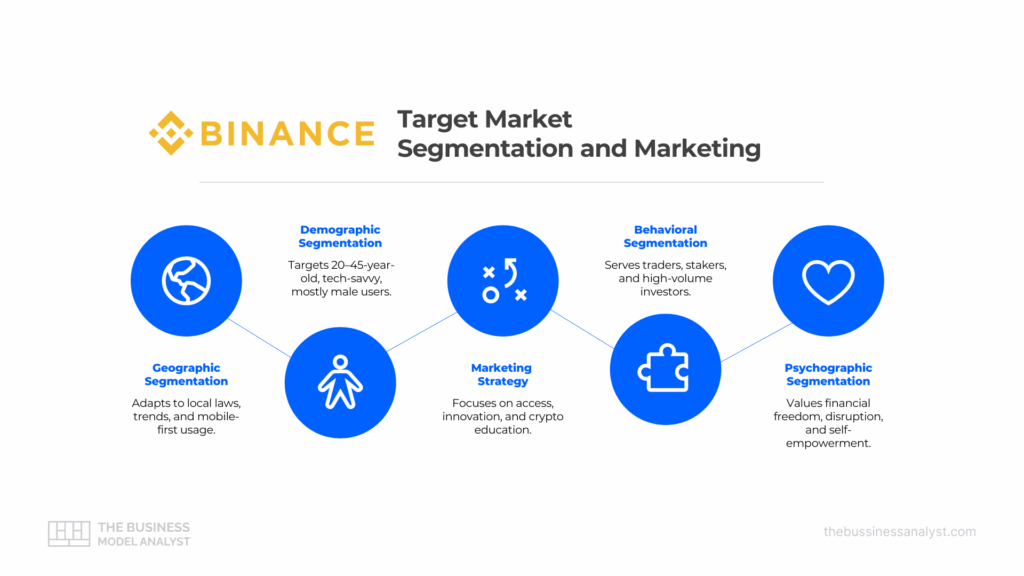
Binance Target Market Segmentation and Marketing
Market segmentation is the process of dividing a broad audience into smaller, more defined groups based on shared characteristics. For Binance, segmentation is critical to efficiently reaching users across regions, experience levels, and financial goals. By understanding who its users are and how they behave, Binance tailors offerings that speak directly to their motivations.
Binance uses four main segmentation types to guide its marketing and product development:
- Demographic segmentation to address users by age, income, and education.
- Geographic segmentation to localize experiences by region or country.
- Behavioral segmentation to respond to how people trade, invest, or use crypto tools.
- Psychographic segmentation to connect with values like independence, innovation, and financial empowerment.
Each of these layers helps Binance build a global platform that feels local and relevant to its users. Whether it’s offering Arabic-language support in the MENA region or launching NFT features for digital creators, Binance adapts its strategy based on deep audience insights.
Next, we’ll explore each of these segmentation types in detail—starting with Demographic Segmentation.
Demographic Segmentation
Demographic segmentation is one of the most fundamental ways Binance identifies and targets its users. It involves breaking down the market by age, gender, income, education, and other measurable traits. These categories help Binance fine-tune both its marketing and product offerings.
Age and Gender
The core Binance target market is largely male, with most users falling between the ages of 25 and 40. This group tends to be highly engaged with technology and open to alternative investments like cryptocurrencies. According to surveys, over 75% of Binance users are male, though the platform has been trying to close the gender gap through campaigns aimed at women in crypto.
Income and Education
Most Binance users are middle to upper-middle income earners. While some are casual investors, many are financially literate individuals—engineers, software developers, and entrepreneurs—who have either disposable income or a strong appetite for risk. Education-wise, a high percentage of Binance users hold university degrees, especially in fields like business, finance, and computer science. Binance Academy, the company’s educational portal, reflects its goal to cater to this self-driven learner segment.
Case in Point: Developing Countries
In places like Brazil and India, Binance’s demographic appeal extends beyond traditional tech-savvy youth. Users in these countries often range from late teens to middle age, and many are turning to crypto as a hedge against unstable fiat currencies or limited job opportunities. The platform’s low fees and mobile-first interface make it accessible even in low-income markets, expanding its demographic reach.
Demographic insights not only shape the platform interface but also its marketing tone. Binance tends to use straightforward, informative language with a modern tech edge—appealing to ambitious, upwardly mobile individuals across education and income levels.
Geographic Segmentation
Geographic segmentation involves dividing a market based on location, such as countries, regions, or urban versus rural areas. Binance operates globally, serving millions of users in over 180 countries, but it customizes its approach depending on regional needs and regulatory environments.
Global Reach with Local Adaptation
Binance’s strongest user bases are in Asia, Africa, Europe, and Latin America. Countries like Nigeria, India, Indonesia, and Brazil have seen rapid growth due to rising interest in cryptocurrencies and limited traditional banking access. Binance’s mobile app and localized payment options are key to attracting users in these emerging markets, where smartphones often serve as the primary internet device.
Regulatory Impact
Geographic segmentation for Binance is also shaped by regulatory landscapes. For example, in the United States, Binance operates Binance.US with a more limited range of offerings to comply with stricter regulations. This localized platform targets American users who demand regulatory security but still want access to crypto trading. Conversely, in countries with fewer crypto regulations, Binance offers a broader suite of products, such as futures trading and margin lending.
Regional Marketing Strategies
Binance tailors marketing campaigns by language, culture, and economic context. In the Middle East and North Africa (MENA), Binance has partnered with local influencers and launched Arabic language support to resonate with users. In India, Binance’s campaigns emphasize education and financial inclusion, reflecting local interest in crypto as an alternative investment.
This geographic segmentation strategy allows Binance to maintain a unified global brand while appealing to diverse local audiences with relevant offerings, pricing, and communication.
Behavioral Segmentation
Behavioral segmentation focuses on how users interact with Binance, examining patterns like trading frequency, product usage, and loyalty. This approach helps Binance personalize experiences and optimize retention.
Usage Frequency and Trading Habits
Binance serves a wide range of users, from casual traders making infrequent spot trades to professional investors engaging in high-frequency margin trading. Some users are attracted by Binance’s broad crypto selection and use it as a primary platform for daily trading. Others prefer staking, lending, or participating in token launches. Binance’s flexible interface and product diversity cater to these varied behaviors.
Subscription and Loyalty Programs
Binance incentivizes loyalty through programs like Binance Earn, VIP tiers, and referral bonuses. These reward users who trade higher volumes or hold Binance’s native token (BNB), encouraging more frequent and larger trades. The VIP program offers discounted fees and exclusive features, effectively segmenting high-value users and nurturing long-term relationships.
Personalization and Retention
Binance leverages behavioral data to tailor product recommendations and marketing. For instance, users who frequently trade altcoins might see promotions about new tokens or DeFi projects. The company’s app also sends alerts for market movements and personalized learning resources, enhancing engagement based on user habits.
This behavioral segmentation helps Binance deepen customer loyalty, reduce churn, and increase lifetime user value by offering experiences aligned with individual preferences and activity levels.
Psychographic Segmentation
Psychographic segmentation examines users’ values, lifestyles, and personalities to understand what motivates their relationship with Binance. This deeper insight helps Binance craft messaging that resonates emotionally and aligns with users’ identities.
Values and Beliefs
Binance’s audience often values financial independence, innovation, and decentralization. Many users see crypto not just as an investment but as a way to challenge traditional financial systems. This mindset is especially strong among younger, tech-savvy users who identify with concepts like transparency and empowerment through blockchain technology.
Lifestyle and Personality
Binance users tend to be early adopters who are curious, risk-tolerant, and eager to learn. They often lead active digital lifestyles, staying connected to news and trends through social media, podcasts, and online communities. Binance’s branding taps into this lifestyle by emphasizing opportunity, disruption, and community.
Emotional Triggers and Brand Connection
The company’s marketing frequently appeals to aspirations—freedom from banks, the promise of wealth creation, and participation in a global movement. Campaigns highlight stories of ordinary users achieving financial breakthroughs through crypto. This approach creates a sense of belonging and motivation, turning users into brand advocates.
For example, Binance’s “Future of Finance” messaging targets those who want to be part of a technological revolution rather than just passive consumers. By aligning its products and content with these psychographic traits, Binance builds a loyal user base that feels understood and inspired.
Binance Marketing Strategy
Binance’s marketing strategy is multifaceted, combining digital advertising, influencer partnerships, and educational content to engage its diverse audience. Social media platforms like Twitter, Instagram, and YouTube play a central role, allowing Binance to share timely updates, tutorials, and community stories.
Education is a core pillar, with Binance Academy providing free resources that build user knowledge and trust. This positions Binance not just as a trading platform but as a thought leader in crypto.
The brand’s messaging emphasizes innovation, accessibility, and empowerment, appealing to both beginners and experienced traders. Influencer collaborations help Binance reach younger, tech-savvy demographics, while localized campaigns address regional needs and languages.
Overall, Binance’s marketing balances broad awareness with targeted engagement, ensuring it remains relevant across varied user segments worldwide.
How Binance Reaches Its Audience
Binance employs a variety of methods to connect with different segments of its audience effectively. These approaches ensure that its global user base receives relevant messaging that matches their experience level, interests, and regional context.
Social Media and Influencer Partnerships
Binance leverages popular social media channels like Twitter, Instagram, and TikTok to engage younger, tech-savvy users. Influencer partnerships amplify its reach, particularly in emerging markets. Crypto influencers demonstrate Binance’s features, share trading tips, and create content that drives trust and user acquisition.
Educational Platforms
Binance Academy offers comprehensive guides and tutorials that appeal to novice users eager to understand cryptocurrencies. This education-first approach nurtures confidence and lowers entry barriers, making crypto accessible. The academy also serves more advanced users with in-depth analysis, fostering long-term engagement.
Localized Campaigns and Events
To resonate with regional audiences, Binance runs localized marketing campaigns tailored to cultural preferences and languages. For example, in Latin America, Binance sponsors crypto meetups and webinars to build community trust. In Asia, the platform often collaborates with regional payment providers to simplify deposits and withdrawals.
Referral and Loyalty Programs
Referral bonuses and VIP loyalty programs incentivize users to stay active and invite others. This word-of-mouth marketing creates organic growth while rewarding Binance’s most engaged customers. These programs are personalized, often tied to user behavior, encouraging deeper platform use.
Comparison to Competitors’ Target Audience
Analyzing Binance’s target market alongside key competitors provides insight into how each exchange positions itself and appeals to different user segments. We’ll focus primarily on Binance compared to Coinbase and Kraken, two prominent players with distinct strategies.
Binance vs Coinbase Target Audience
Coinbase targets a more conservative, beginner-friendly demographic, especially in North America and Europe. Its users tend to be older, with higher average incomes and a preference for straightforward, regulated platforms. Coinbase appeals to those seeking ease of use and regulatory assurances rather than advanced trading features.
In contrast, Binance’s audience skews younger and more global, with significant representation in emerging markets. Binance users are often more risk-tolerant, attracted to Binance’s extensive product range, including futures and DeFi tools. While Coinbase focuses on simplicity, Binance appeals to users who want depth and variety in their crypto experience.
Binance vs Kraken Target Audience
Kraken positions itself as a secure, institutional-friendly exchange catering to experienced traders and professional investors. Its user base typically values strong compliance and security features. Kraken appeals to users who prioritize trust and regulatory clarity over flashy features.
Binance, meanwhile, balances both retail and institutional users but has a broader global footprint. It attracts users interested in innovation and accessibility. While Kraken emphasizes stability and regulatory compliance, Binance’s target audience embraces rapid innovation and higher-risk trading products.
Similarities in Target Audiences
Both Binance and its competitors serve users passionate about cryptocurrencies and blockchain technology. They appeal to individuals valuing security, innovation, and financial opportunity. All three exchanges recognize the importance of education and community building to foster user trust.
Key Differences in Target Audiences
The primary distinctions lie in geographic focus and user sophistication. Binance’s aggressive global expansion contrasts with Coinbase’s North American regulatory focus and Kraken’s institutional niche. Binance’s brand identity embraces bold innovation, while competitors highlight trust and ease of use. These differences shape how each company builds loyalty and engagement.
Binance Advantages
- Global Reach and Accessibility – Binance’s presence in over 180 countries allows it to tap into emerging markets overlooked by competitors, fueling rapid user growth.
- Product Diversity – Binance offers a comprehensive suite of trading tools, DeFi options, and NFTs, appealing to a wide range of user interests and experience levels.
- Competitive Fees – Binance’s low transaction fees and incentives make it attractive for high-volume traders and cost-conscious users alike.
- Educational Resources – Binance Academy positions the brand as a leader in crypto education, fostering long-term user engagement and trust.
Binance Disadvantages
- Regulatory Challenges – Binance faces scrutiny in several jurisdictions, affecting its reputation and limiting product availability in some markets.
- Complexity for Beginners – The platform’s wide range of features can overwhelm new users, potentially driving them toward simpler competitors like Coinbase.
- Trust Perception Issues – Due to past regulatory warnings, some users question Binance’s compliance and security compared to more regulated exchanges.
- Inconsistent User Experience Across Regions – Localization efforts vary, sometimes leading to uneven service quality or access depending on location.
Conclusion
In summary, Binance’s success largely stems from its deep understanding of its target market—a global, diverse audience united by a shared interest in innovation, financial empowerment, and cryptocurrency opportunities. By segmenting users demographically, geographically, behaviorally, and psychographically, Binance tailors its products, marketing, and user experience effectively.
Compared to competitors like Coinbase and Kraken, Binance excels in global reach, product diversity, and cost competitiveness. However, regulatory challenges and complexity remain obstacles to wider adoption among beginners and certain markets.
As the crypto landscape evolves, Binance’s ability to adapt segmentation strategies and enhance trust will be critical. Maintaining its balance between innovation and compliance, while simplifying user experiences, will help Binance retain and expand its audience in a competitive, fast-changing environment.
This thorough understanding of the Binance target market ensures the company remains a dominant force in cryptocurrency trading worldwide.


