
Toyota Target Market Analysis
Jul
Understanding a company’s target market is crucial to building a strong brand and sustaining long-term success. In today’s highly competitive automotive industry, knowing who your ideal customer is—and how to connect with them—can define the trajectory of your entire business. This is particularly true for global car manufacturers, who must balance broad appeal with regional relevance.
Toyota, a household name in the automobile industry, has consistently ranked among the top car manufacturers worldwide. Known for its reliability, fuel efficiency, and commitment to innovation, Toyota has established a strong foothold in both developed and emerging markets. Whether it’s the family-friendly Corolla, the rugged Tacoma, or the eco-conscious Prius, Toyota designs vehicles that resonate with different consumer lifestyles and priorities.
In this article, we’ll explore the Toyota target market in depth. We’ll uncover who their ideal customers are, how the company segments its audience, and how it tailors its marketing to fit varying needs. We’ll also compare Toyota’s approach with that of competitors like Honda and Ford to reveal what sets its strategy apart. Whether you’re a marketer, competitor, or simply curious, this analysis will offer insight into how one of the world’s biggest brands stays in tune with its diverse audience.
Contents
Who is Toyota’s Target Audience?
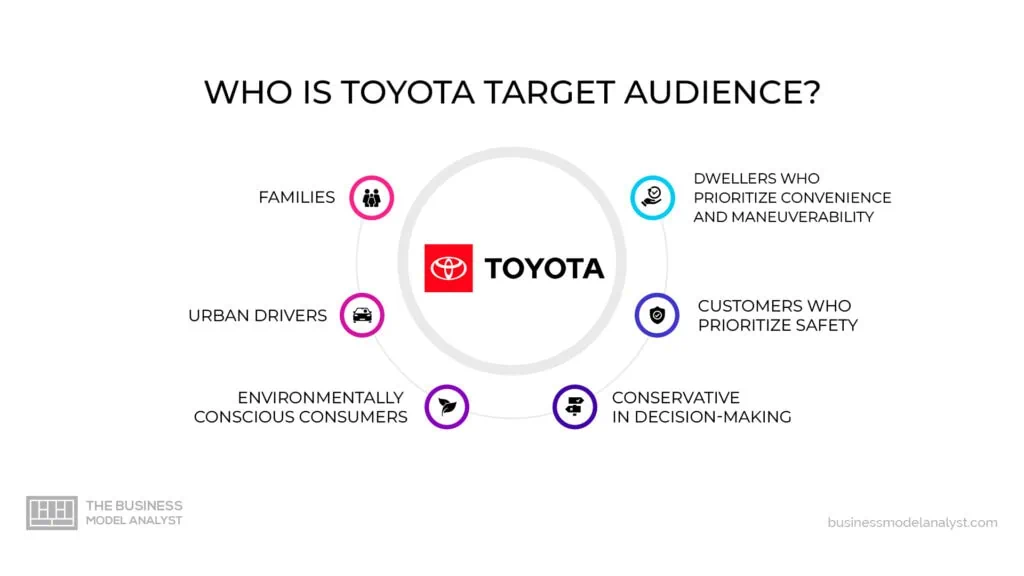
Toyota’s core audience is remarkably broad, but it’s anchored by a focus on middle-income consumers seeking reliability, efficiency, and long-term value. The brand appeals to a wide demographic, spanning young professionals to retirees, but the typical Toyota customer tends to fall within the 25 to 54 age range. This group values practicality over flashiness and views car ownership as a long-term investment.
Gender representation is nearly balanced, although certain models skew toward particular segments. For instance, the Toyota Camry and Corolla attract both men and women equally due to their reputation for dependability and safety. Meanwhile, models like the rugged Toyota Tacoma and off-road 4Runner have stronger appeal among male buyers interested in utility and adventure.
Toyota’s target market often falls into the middle to upper-middle income bracket, typically earning between $50,000 and $100,000 annually. These customers prioritize cost-effectiveness and total cost of ownership, making Toyota’s strong resale value and low maintenance costs key selling points. The brand also appeals to environmentally conscious consumers through hybrid models like the Prius and RAV4 Hybrid, speaking to values beyond simple economics.
Lifestyle is a crucial factor. Toyota customers are often suburban families, daily commuters, or outdoor enthusiasts. They want cars that are safe, efficient, and versatile. For example, the Toyota Highlander is popular among families due to its spaciousness and high safety ratings. In contrast, the Toyota GR Supra targets performance-driven younger buyers interested in sporty aesthetics and speed.
Overall, the Toyota target market is composed of pragmatic consumers who value function, durability, and brand trust. Toyota’s ability to serve such a broad yet distinct audience lies in its well-diversified product lineup and consistent delivery on quality promises.
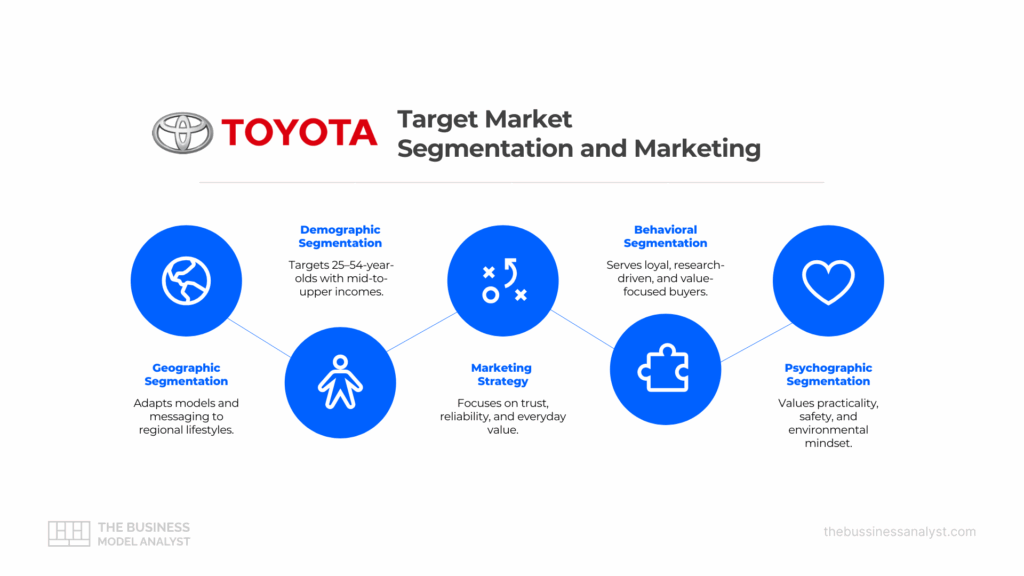
Toyota Target Market Segmentation and Marketing
Market segmentation is the practice of dividing a broad consumer base into sub-groups based on shared characteristics. This enables companies to tailor messaging, design products, and select channels that better align with each group’s unique needs. Toyota employs a multi-segment marketing strategy, allowing it to reach vastly different customers with precision and relevance.
Toyota’s segmentation strategy is built around four key areas: demographic, geographic, behavioral, and psychographic. By analyzing data in each category, Toyota designs products and campaigns that resonate deeply with specific audience segments. For instance, the Toyota Prius targets eco-conscious urban professionals, while the Toyota Tacoma serves rural and outdoor-oriented customers.
Each vehicle model is positioned to reflect the values and expectations of its segment. Toyota does not rely on a one-size-fits-all approach. Instead, it customizes marketing strategies for different models, regions, and buyer personas. This has helped the company stay relevant across global markets and changing consumer trends.
In the following sections, we’ll explore how Toyota applies each type of segmentation to refine its marketing and connect with its audience more meaningfully.
Demographic Segmentation
Demographic segmentation involves dividing the market based on measurable statistics like age, gender, income, and education. Toyota has effectively used demographic insights to align specific vehicle models with targeted customer profiles.
Toyota’s broad appeal allows it to cater to multiple age groups, but key segments include young professionals (25–34) and middle-aged adults (35–54). Younger buyers often gravitate toward models like the Toyota Corolla or C-HR—compact, stylish, and affordable options suited for urban living and first-time ownership. Meanwhile, more established adults with families prefer the Toyota Highlander or RAV4 for their safety features, space, and long-term reliability.
In terms of income, Toyota primarily targets the middle to upper-middle-income range, typically between $50,000 and $100,000 annually. These consumers are value-conscious and consider both upfront costs and long-term maintenance. The availability of both economy models and luxury-adjacent offerings like the Toyota Avalon allows the brand to serve various income levels without diluting its identity.
Gender segmentation is subtly applied across the product range. While Toyota does not overtly market vehicles by gender, purchase data reveals tendencies. SUVs like the RAV4 often appeal to women due to safety and family-friendliness, while trucks like the Toyota Tacoma and Tundra skew more male, aligning with utility and performance preferences.
Education also plays a role. Many Toyota buyers are college-educated professionals who view vehicle purchase through a rational lens—reliability, fuel efficiency, and resale value matter more than flashy features. This practical mindset aligns closely with Toyota’s brand promise.
By aligning specific models with distinct demographic profiles, Toyota creates a diverse product line that meets the nuanced needs of different groups—all while maintaining a coherent brand image grounded in trust and efficiency.
Geographic Segmentation
Geographic segmentation allows companies to adapt their offerings based on the location of their consumers. For a global brand like Toyota, this is a crucial part of its strategy. Toyota operates in more than 170 countries, and it fine-tunes its marketing, production, and model availability to meet regional needs and climate, infrastructure, and consumer habits.
In North America, Toyota emphasizes safety, fuel efficiency, and reliability. The RAV4 and Camry are top-sellers in the U.S. and Canada, appealing to suburban families and daily commuters. The popularity of pickup trucks like the Tacoma and Tundra reflects a regional affinity for rugged, utility-oriented vehicles—especially in the Midwest and Southern states.
In Asia, Toyota customizes offerings based on urban density and pricing sensitivity. In India, for instance, the company offers more compact, fuel-efficient models like the Toyota Glanza and Urban Cruiser, designed to appeal to cost-conscious urban dwellers. In Japan, kei cars and hybrids are popular due to space limitations and environmental regulations, leading to models like the Toyota Aqua.
In Europe, Toyota focuses on hybrid and electric vehicles to comply with strict emission regulations. The Yaris Hybrid and Corolla Touring Sports are optimized for compact city driving and fuel savings. Toyota’s marketing in European markets often emphasizes sustainability and innovation.
Toyota also localizes advertising to match cultural values. For instance, in the Middle East, the Land Cruiser is positioned as a symbol of strength and tradition, while in Australia, ads highlight Toyota’s durability in rough terrains, reflecting the country’s vast rural areas.
Through geographic segmentation, Toyota ensures it doesn’t just sell cars—it builds regional trust by aligning with local lifestyles and expectations.
Behavioral Segmentation
Behavioral segmentation focuses on how customers interact with a product or brand—what they buy, how often, and why. Toyota excels in this area by tailoring its strategies based on consumer behavior patterns such as usage frequency, loyalty, and buying motivations.
One of Toyota’s most successful behavioral strategies lies in its hybrid and electric vehicle (EV) offerings. Many customers who choose models like the Prius or RAV4 Hybrid are not just environmentally conscious—they’re also repeat buyers seeking fuel efficiency and long-term savings. Toyota nurtures this loyalty through education campaigns, early access to upgrades, and consistent product innovation.
Toyota also uses tiered offerings to match user behavior. For example, a customer looking for a dependable commuter car might choose the base model Corolla, while another who wants premium features might opt for a Corolla XSE with tech and safety enhancements. This segmentation allows Toyota to capture different value perceptions within the same product line.
Purchase timing and decision-making also inform Toyota’s approach. Many Toyota buyers are research-oriented and cautious, spending more time reviewing safety scores, mileage, and customer reviews. Toyota’s digital platforms cater to this behavior with comprehensive comparison tools, online configurators, and transparent pricing options.
Another key tactic is the ToyotaCare program—a no-cost maintenance plan for two years or 25,000 miles. This offer appeals to behaviorally cautious buyers who want assurance and low initial upkeep costs. It also builds post-sale loyalty, encouraging customers to return for future purchases or service needs.
Behavioral segmentation also informs regional marketing. In colder climates, for instance, Toyota promotes all-wheel-drive features and heated seats, while in hot regions, air-conditioning performance and heat-resistant interiors are highlighted.
By closely monitoring and responding to how customers behave before, during, and after purchase, Toyota continues to refine its customer experience, encouraging long-term loyalty and repeat engagement.
Psychographic Segmentation
Psychographic segmentation dives into lifestyle, values, personality traits, and beliefs, offering a deeper look at what drives purchasing decisions beyond basic demographics. Toyota leverages this segmentation by aligning its branding and messaging with consumers’ core identities and emotional motivations.
Toyota customers often value practicality, dependability, and sustainability. These are not just product features—they are reflections of how buyers see themselves. For example, the Prius doesn’t only sell because it’s fuel-efficient. It appeals to eco-conscious individuals who want their car to reflect a commitment to environmental responsibility. In this way, Toyota connects with customers who place high value on ethical consumption and long-term impact.
Toyota’s psychographic strategy also captures audiences who prioritize family, safety, and peace of mind. Campaigns for vehicles like the Toyota Highlander or Sienna emphasize family-first narratives, showcasing road trips, school pickups, and secure travels. These messages resonate strongly with consumers whose self-concept includes being a protector or caregiver.
Performance-oriented models like the Toyota GR Supra or GR86 cater to a different psychographic: thrill-seekers and car enthusiasts. These buyers identify with speed, design, and individuality. Toyota speaks to this mindset through bold, adrenaline-fueled campaigns and limited-edition drops that generate exclusivity.
Psychographic traits also guide Toyota’s tone and media choices. The brand avoids flashy luxury or aggression in its mainstream messaging, instead favoring trustworthiness, responsibility, and approachability. This tone aligns with audiences who are rational, community-minded, and forward-thinking.
By tapping into deeper motivations—like environmental stewardship, family loyalty, or personal identity—Toyota creates campaigns that do more than sell cars. They reinforce values, build emotional loyalty, and shape how consumers see themselves behind the wheel.
Toyota Marketing Strategy
Toyota’s marketing strategy is grounded in consumer trust, reliability, and innovation. Instead of relying on flashy promotions or luxury branding, Toyota consistently emphasizes practical value and peace of mind. This approach helps the brand stay connected to its diverse audience across economic, cultural, and geographic lines.
Toyota uses a multi-channel marketing mix to reach its customers. Television and digital advertising remain central, supported by strong social media engagement, especially on platforms like YouTube, Instagram, and TikTok for younger demographics. Toyota also invests heavily in event sponsorships, such as the Olympic and Paralympic Games, to reinforce its global presence and inclusive image.
The company’s messaging is emotionally grounded, often centered on themes like safety, family, and environmental responsibility. Toyota campaigns rarely boast about luxury or status; instead, they celebrate everyday experiences and long-term reliability. This down-to-earth messaging aligns with Toyota’s brand promise and deeply resonates with its audience.
In regions with specific values—like sustainability in Europe or resilience in the American heartland—Toyota adapts its messaging accordingly. This blend of global consistency and local relevance has helped Toyota maintain a strong, trustworthy brand identity across multiple markets and generations.
How Toyota Reaches Its Audience
Toyota’s ability to communicate with such a broad customer base lies in its multi-pronged outreach strategy, which blends traditional media, digital platforms, in-person experiences, and localized engagement. The brand understands that different segments require different touchpoints and messages—so it adapts accordingly.
Social Media and Influencer Collaborations
Toyota maintains a strong presence on platforms like Instagram, YouTube, and TikTok, using visually engaging content to showcase new models, tech features, and behind-the-scenes looks at vehicle design. Influencer partnerships play a key role, especially with creators focused on sustainability, tech, or adventure travel. For instance, influencers often highlight Toyota’s hybrid lineup on eco-lifestyle channels, creating authentic endorsements.
Regional and Cultural Advertising
Toyota tailors campaigns to fit local customs and values. In the U.S., commercials often emphasize family and freedom—common themes in Toyota Camry and RAV4 ads. In contrast, in Japan, Toyota highlights compact efficiency and urban maneuverability, catering to city life. In Australia, rugged terrain ads for the Hilux tap into a cultural image of outdoor resilience.
Event Sponsorships and Sports Marketing
Toyota’s sponsorship of global events like the Olympics and Paralympics reinforces its image as a reliable, innovative, and socially responsible brand. These sponsorships aren’t just about visibility—they communicate Toyota’s values of endurance, inclusivity, and global unity. Regionally, Toyota sponsors local sports teams and community events to build trust at the grassroots level.
Dealer Experience and Community Integration
Toyota’s dealership network plays a critical role in local outreach. Dealers are trained to reflect Toyota’s customer-first philosophy, and many offer community programs, including free maintenance clinics, local sponsorships, and test-drive events. This human connection is especially vital in suburban and rural areas where word-of-mouth matters most.
By combining digital reach, cultural nuance, and personal engagement, Toyota maintains a strong connection with its customers throughout the buyer journey—from awareness to purchase and beyond.
Comparison to Competitors’ Target Audience
Toyota vs Honda Target Audience
Toyota and Honda both resonate strongly with practical, value-driven buyers, but there are nuanced differences. Toyota’s appeal spans compact cars, hybrids, trucks, and SUVs, giving it broad coverage across life stages and preferences. Honda, by contrast, focuses more on its strengths in compact sedans and midsize SUVs, such as the Civic and CR-V, which tend to attract younger buyers and urban professionals more directly.
Psychographically, both brands emphasize reliability and economy, but Honda often leans toward sportier, tech-savvy personas—its Civic Type R, for example, appeals to driving enthusiasts. Toyota addresses a wider psychographic range: its lineup includes performance-driven GR models for thrill-seekers and hybrids like the Prius for eco-conscious buyers. That wider range lets Toyota adapt to more distinct consumer mindsets than Honda.
Toyota vs Ford Target Audience
When comparing Toyota to Ford, we see clear strategic differences. Ford is known for its appeal to blue-collar and utility-focused customers, especially with its F-Series trucks. These buyers value power, towing capacity, and status, a proposition Ford leans into heavily. Toyota does engage this segment with its Tacoma and Tundra but positions them more around durability and long-term value rather than raw power.
Ford’s marketing often emphasizes American tradition, toughness, and lifestyle ambition—echoing psychographic drivers like resilience and capability. Toyota’s messaging in trucks emphasizes engineering longevity and cost-efficiency, appealing to buyers who want solid performance without the flash. Ford trucks may skew slightly younger and more male-dominated, while Toyota reaches a more conservative, budget-conscious demographic.
Similarities in Target Audiences
Both Toyota and its competitors share these audience traits: a strong preference for reliable, value-oriented vehicles, often within the middle-to-upper income range. Their customers tend to be research-driven and brand loyal, emphasizing safety, technology, and resale value. Shared psychographics include a desire for functionality, economic sensibility, and brand trust.
Key Differences in Target Audiences
Toyota’s advantage lies in its hybrid and eco-focused offerings, making it more appealing to environmentally conscious consumers than Ford or Honda. Meanwhile, Ford’s strength in rugged, high-performance trucks appeals to buyers prioritizing power and status. Honda skews more urban and youth-focused with sportier designs and tech-forward features, while Toyota offers broader appeal, including green, family, and lifestyle segments under one brand umbrella.
Toyota Advantages
- Exceptional Hybrid Leadership – Toyota’s early investment in hybrid technology has made the Prius and hybrid RAV4 household names. This leadership attracts eco-minded buyers and provides a distinct brand identity.
- Global Product Diversity – Toyota’s extensive lineup—from micro-cars in Asia to SUVs and trucks globally—allows the brand to target multiple segments effectively, increasing reach and reducing reliance on a single market.
- Strong Residual Values – Toyota vehicles consistently achieve high resale values, reassuring middle-income buyers and building consumer trust.
- Universal Brand Trust – Toyota’s reputation for reliability spans generations and cultures, creating strong loyalty that competitors find difficult to match.
Toyota Disadvantages
- Perceived Conservative Image – Toyota’s brand is often seen as safe and reliable but less exciting. In contrast, competitors like Ford and Honda may be viewed as more adventurous or sporty.
- Lagging BEV Innovation – Toyota was late to fully embrace battery-electric vehicles (BEVs), giving brands like Tesla and Ford a head start in the growing EV market.
- Premium Segment Gaps – Toyota lacks presence in the ultra-luxury segment, where brands like Mercedes-Benz and BMW dominate. This limits appeal to affluent buyers.
- Complex Model Lines – With so many variants and trims across models, consumers can feel overwhelmed by Toyota’s choices, potentially driving them to more streamlined rival offerings.
Conclusion
Understanding the Toyota target market reveals how one of the world’s largest automakers successfully balances broad appeal with strategic precision. Toyota’s strength lies in its ability to serve families, eco-conscious consumers, outdoor enthusiasts, and budget-minded drivers—all without losing its core brand identity rooted in reliability and long-term value.
Through effective segmentation—demographic, geographic, behavioral, and psychographic—Toyota crafts tailored campaigns and region-specific offerings that resonate deeply with diverse customer groups. Its marketing strategy combines global reach with local sensitivity, while its product diversity ensures relevance across changing consumer needs.
As the market evolves, especially with the rise of electric vehicles and shifts in mobility preferences, Toyota’s future will depend on adapting quickly while preserving the values that have earned it lasting loyalty. By continuing to listen, segment wisely, and evolve responsibly, Toyota is well-positioned to keep driving customer trust for generations to come.


