
Ford Target Market Analysis
Jul
Understanding a company’s target market is essential to crafting products, campaigns, and experiences that resonate with the right people. It helps businesses allocate resources wisely and stay competitive in changing economic landscapes. For automakers like Ford, identifying and connecting with their ideal consumers is not just beneficial—it’s vital for survival in a crowded market.
Ford Motor Company, a global automotive leader, has played a major role in shaping the industry since its founding in 1903. Known for iconic vehicles such as the F-150, Mustang, and Explorer, Ford offers a wide range of cars, trucks, and SUVs designed to meet the needs of diverse customers. The brand operates in over 100 markets, adapting its strategies to suit both regional preferences and global trends like electrification and digital mobility.
This article provides a comprehensive Ford target market analysis. We’ll explore who Ford’s primary customers are, how the company segments them, and what marketing strategies it uses to connect with different groups. We’ll also compare Ford’s audience with its competitors, highlighting strategic advantages and areas for growth. Whether you’re a marketer, investor, or industry observer, understanding Ford’s audience strategy offers valuable insights into what makes this automotive giant tick.
Contents
Who is Ford Target Audience?
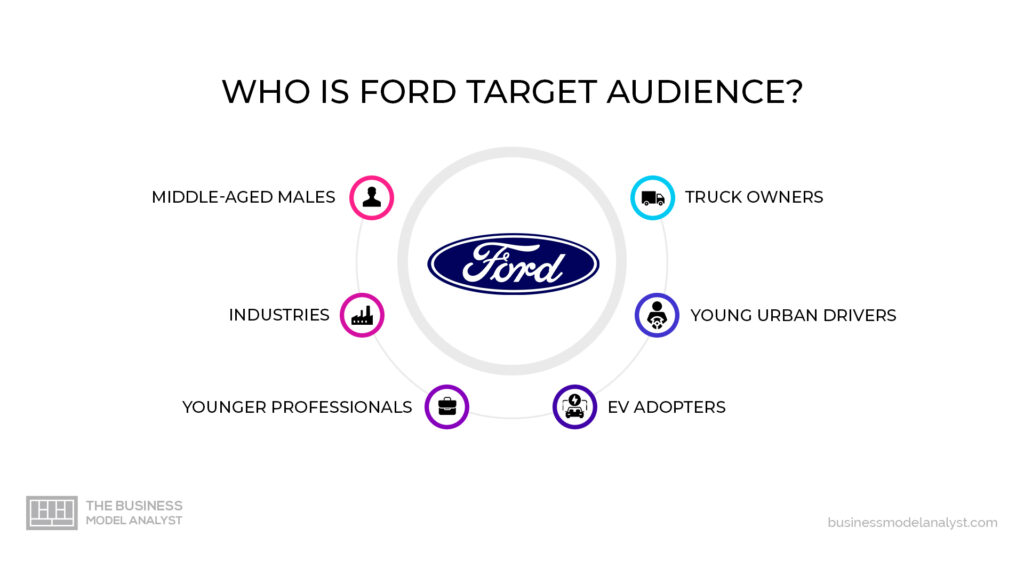
The Ford target market spans a broad demographic, reflecting the company’s diverse vehicle lineup. From rugged pickup trucks for tradespeople to compact SUVs for urban families, Ford builds vehicles for practical, hardworking consumers. Its primary audience tends to value reliability, performance, and affordability, with a growing interest in sustainability and tech innovation.
Ford’s core customer base includes men and women aged 30 to 65, often from middle- to upper-middle-income brackets. Many are homeowners and parents who prioritize safety, space, and durability. These consumers are typically working professionals, tradespeople, small business owners, or retirees. Ford trucks, especially the F-Series, are extremely popular among blue-collar workers, construction firms, and rural residents due to their towing capabilities and rugged build.
In contrast, Ford’s SUVs and crossovers—like the Escape and Explorer—cater more to suburban families and younger professionals. These buyers tend to be tech-savvy and budget-conscious, interested in fuel efficiency, smart infotainment systems, and versatile cargo space. Ford’s investments in hybrid and electric models, such as the Mustang Mach-E and F-150 Lightning, aim to attract environmentally conscious drivers and early tech adopters.
Ford also appeals to loyalists with emotional brand ties. Long-time buyers often cite heritage, trust, and Made-in-America pride as reasons for sticking with the brand. This sense of brand loyalty is particularly strong in rural and southern U.S. markets, where Ford’s reputation for ruggedness and practicality is deeply rooted.
Ford Target Market Segmentation and Marketing
Market segmentation is the practice of dividing a broad consumer base into distinct groups with shared characteristics. This approach allows companies like Ford to tailor products, messages, and campaigns more effectively to specific audiences. By understanding what motivates different types of customers, Ford can optimize its design, pricing, and marketing strategies across various segments.
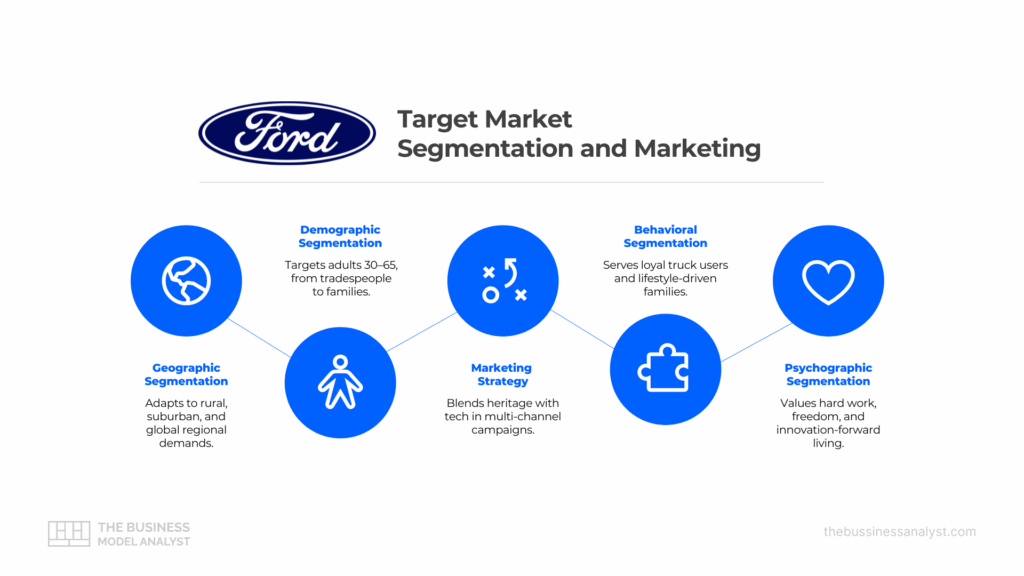
The Ford target market is segmented into four key categories: demographic, geographic, behavioral, and psychographic. These segmentation strategies help Ford reach everyone from urban commuters to rural contractors, and from environmentally minded Millennials to traditionalist Baby Boomers.
Each type of segmentation plays a role in shaping how Ford communicates and delivers value. For example, demographic segmentation allows Ford to market SUVs to family-oriented buyers, while behavioral segmentation helps target pickup promotions at those with specific work-related vehicle needs.
Demographic Segmentation
Demographic segmentation divides the market based on quantifiable traits such as age, gender, income, and education. Ford relies heavily on this approach to match different vehicle models with well-defined customer groups, ensuring that each product speaks directly to its intended users.
Age and Gender
Ford targets a wide age range, but distinct age groups gravitate toward specific vehicles. The F-Series trucks—America’s best-selling vehicle line for decades—primarily attract males aged 35 to 64. These are typically blue-collar workers or business owners in trades who need a reliable workhorse. Meanwhile, SUVs like the Escape and Edge tend to appeal to younger families and women in their 30s and 40s, drawn by safety ratings, tech features, and versatility.
The Mustang continues to draw a younger male audience in their 20s to early 40s, often those seeking performance and identity expression. On the other end, Ford’s hybrid and electric offerings—like the Mustang Mach-E—are targeting tech-savvy Millennials and Gen Z buyers looking for performance, style, and environmental consciousness.
Income and Education
Most of Ford’s core customers fall into the middle- and upper-middle-income brackets, earning between $50,000 and $120,000 annually. Vehicles like the Ford Maverick, an affordable compact pickup, are tailored for younger buyers or cost-conscious urban drivers. In contrast, the F-150 Lightning or fully equipped Expeditions can exceed $70,000, targeting higher-income professionals and families.
Education levels vary. Ford truck buyers are often high school or trade school graduates working in hands-on industries, while SUV and EV buyers often have college degrees and work in white-collar or tech fields.
Ford aligns vehicle features and advertising to these demographic realities. For instance, digital ads for the Mach-E highlight advanced tech and clean design—appealing to educated, affluent Millennials. Truck campaigns, in contrast, emphasize power, payload, and toughness, resonating with a more traditional, value-driven male demographic.
Geographic Segmentation
Geographic segmentation involves tailoring marketing efforts and products based on the physical location of customers. For Ford, geography plays a critical role in shaping product demand, especially in a country as large and diverse as the United States, and in its international markets.
In the U.S., rural and suburban regions are strongholds for Ford trucks and SUVs. The F-150, for example, remains the top-selling vehicle in states like Texas, where towing power and off-road capability are essential. Ford’s marketing in these regions emphasizes ruggedness and durability, often using images of farms, job sites, or wide-open landscapes to connect with local values and work habits.
In urban areas and coastal cities, the picture changes. Compact models like the Ford Escape or EcoSport are promoted as nimble, fuel-efficient vehicles ideal for city life. These vehicles often appear in marketing that showcases smart technology, tight parking, and modern lifestyles. In places like California and New York, Ford has ramped up marketing for its electric and hybrid vehicles, aligning with stricter emissions standards and higher environmental awareness.
Globally, Ford adjusts its offerings and campaigns based on regional preferences. In Europe, where roads are narrower and fuel prices higher, Ford’s compact cars like the Focus and Puma are more popular than trucks. Meanwhile, in Latin America and Australia, the Ranger pickup truck is a bestseller and marketed similarly to the F-150 in the U.S.
This localization strategy allows Ford to stay relevant in each region it serves, while also aligning production and pricing to regional economic conditions and consumer behaviors.
Behavioral Segmentation
Behavioral segmentation focuses on how customers interact with a brand, including buying patterns, product usage, brand loyalty, and responsiveness to promotions. Ford uses this approach to refine its marketing and product development, delivering the right messages and incentives to customers based on their real-world actions and preferences.
Usage and Purchase Habits
One of Ford’s clearest behavioral segments is frequent truck users, such as construction workers, contractors, and rural residents. These customers prioritize durability, towing capacity, and low maintenance costs. Ford responds with targeted messages around performance, as seen in the F-Series’ “Built Ford Tough” campaign. These buyers often choose high-trim models with work-focused features and have longer vehicle ownership cycles.
In contrast, SUV and crossover buyers often look for daily drivability and family-friendly features. Many are repeat customers who upgrade every few years as family needs or tech expectations evolve. Ford’s Escape, Explorer, and Bronco Sport are marketed to these lifestyle-focused buyers through features like safety tech, cargo space, and infotainment systems.
Loyalty and Personalization
Ford leverages its FordPass Rewards program to encourage repeat business. Through this system, customers earn points for purchases and service visits, which can be redeemed for discounts and services. The program deepens brand loyalty, particularly among those who already own multiple Ford vehicles or service them at dealerships.
Ford also collects data through connected vehicle systems to offer personalized experiences, like maintenance reminders, driver behavior tips, or remote vehicle controls. These insights feed into email campaigns or app notifications tailored to specific customer habits, making the brand more responsive and useful in daily life.
Psychographic Segmentation
Psychographic segmentation digs into the psychological and emotional traits of a target market—values, lifestyles, attitudes, and aspirations. For Ford, this form of segmentation is vital in appealing to customers on a deeper, more personal level. It allows the company to connect with drivers not just based on needs, but also on who they are and what they believe in.
Values and Lifestyle
Ford appeals to customers who value freedom, hard work, and self-reliance. These traits are prominently reflected in the branding of its truck line, especially the F-Series, which speaks to Americans who see their vehicle as a tool for independence and productivity. Ford’s marketing often aligns with traditional values, such as patriotism, craftsmanship, and resilience—particularly in rural and working-class communities.
At the same time, Ford is evolving to reflect modern lifestyles. With the rise of sustainability and tech-forward thinking, the company is positioning its EV lineup, like the Mustang Mach-E and F-150 Lightning, toward eco-conscious consumers who see clean energy and innovation as essential to their identity. These buyers are often urban professionals or Millennials who want high performance without compromising their ethical values.
Personality and Emotional Triggers
The emotional triggers Ford employs vary by segment. For truck buyers, it’s about strength, reliability, and pride—appealing to a personality that values toughness and dependability. Campaigns often feature gritty visuals and narratives of hard work, tapping into a sense of personal and cultural identity.
For its electric and hybrid lineup, the brand emphasizes innovation, empowerment, and modernity. Ads for the Mach-E, for example, lean into sleek aesthetics and cutting-edge features, sparking feelings of being ahead of the curve. These emotional appeals connect with people who view their car as an extension of their progressive and forward-thinking self.
Ford Marketing Strategy
Ford’s marketing strategy is rooted in its ability to balance tradition with innovation. The company leverages a multi-channel approach to reach different segments of the Ford target market, from long-time truck loyalists to new EV adopters. Its campaigns often blend emotional storytelling with practical messaging, helping the brand resonate across generations.
Ford invests heavily in digital and traditional media, including television, YouTube, social media platforms like Instagram and Facebook, and increasingly, TikTok to engage younger audiences. Influencer partnerships, especially in the automotive and tech spaces, help extend Ford’s reach to niche communities. Paid search and display ads are used to drive traffic to regional dealership sites, while email marketing keeps current owners engaged with service offers and new model announcements.
The brand also tailors its message style based on vehicle category. Truck and SUV ads often spotlight grit, durability, and purpose—reinforcing Ford’s rugged image. In contrast, its EV campaigns emphasize performance, style, and eco-conscious values, appealing to forward-thinking consumers.
How Ford Reaches Its Audience
Experiential Marketing & Brand Events
Ford organizes live events like truck demos, off-road experiences, and test-drive tours. These hands-on experiences—such as the “Built Ford Tough” roadshows or Bronco Off-Roadeo events—enable prospective buyers to feel vehicle capabilities firsthand.
Targeted Digital Campaigns
Digital channels allow Ford to reach different audience segments with acute precision. For example, social media ads offering Mach-E lease deals target eco-conscious Millennials, while Facebook video ads highlighting towing specs are directed at rural truck buyers.
Influencer & Sponsorship Collaborations
Ford partners with influencers across automotive, outdoor, and tech verticals. On the EV front, the company works with clean-tech reviewers to promote models like the Mach-E. Sponsorships of events like NASCAR and the PGA Tour also boost Ford’s visibility among enthusiast audiences.
Dealer-Level Engagement
Local dealerships play a vital role. They host community events and promote the FordPass app, which offers exclusive perks, loyalty points, and appointment tools—key for building trust and ongoing relationships.
Comparison to Competitors’ Target Audience
Ford vs Chevrolet Target Audience
Both brands appeal to working-class and middle-income American families, especially in the truck and SUV space. Chevrolet leans more value-focused, while Ford emphasizes toughness and innovation, especially with its EV investments.
Ford vs Tesla Target Audience
Tesla appeals to early tech adopters, urban professionals, and status-seekers. Ford’s EV buyers often share these values but are drawn to a blend of heritage and innovation. Tesla’s audience is more homogenous, while Ford serves a wider base.
Similarities in Target Audiences
All three brands attract middle- to upper-income consumers and appeal through innovation, safety, and emotional storytelling. Their EV segments overlap, particularly among younger, eco-conscious buyers.
Key Differences in Target Audiences
Ford balances tradition and progress. Chevrolet focuses on cost-conscious families, while Tesla targets tech-forward consumers. These differences shape how each brand retains loyalty and crafts emotional appeal.
Ford Advantages
- Heritage-Driven Brand Loyalty: Ford’s long-standing reputation for building reliable, American-made vehicles fosters deep emotional loyalty, especially among truck buyers. The F-Series’ decades-long dominance reinforces this bond. Unlike newer brands, Ford leverages generational trust, allowing it to retain legacy customers while still introducing new innovations without alienating its core audience.
- Diverse Product Line for Broad Appeal: From affordable hybrids like the Ford Maverick to high-performance EVs like the Mach-E, Ford offers vehicles across price points and lifestyles. This range allows the brand to target multiple demographics—urban commuters, rural workers, eco-conscious families—without overcommitting to one niche, giving it an edge over brands with narrower product portfolios.
- Strong Dealer Network and Customer Service Touchpoints: Ford’s widespread dealership infrastructure ensures accessible service and sales in both urban and rural markets. Local relationships, community events, and the FordPass loyalty app create personalized touchpoints that deepen customer engagement. This localized presence is something Tesla and other direct-to-consumer brands struggle to match at scale.
- Dual Identity: Innovation Meets Tradition: Ford uniquely balances its heritage with forward-looking technology. The use of legacy nameplates like “Mustang” and “F-150” for EV models bridges past and future, making innovation feel familiar. This branding strategy allows Ford to attract new customers without abandoning those drawn to its traditional, dependable image.
Ford Disadvantages
- Less EV Brand Recognition than Tesla: While Ford has made strides with the Mustang Mach-E and F-150 Lightning, it still lacks the electric-first identity that Tesla owns. Tesla’s name is nearly synonymous with EVs, attracting early adopters by default. Ford must work harder to convince tech-savvy buyers that it’s a serious player in the electric mobility space, especially when car-sharing alternatives like the Zipcar business model offer urban flexibility.
- Limited Appeal in Urban EV Segments: Ford’s EV offerings skew toward larger vehicles, which can be a mismatch for urban dwellers prioritizing compact size and convenience. Compared to Tesla’s Model 3 or Chevrolet’s Bolt, Ford has fewer options tailored for city driving. This limits the brand’s reach among environmentally minded, space-conscious consumers in dense metropolitan areas.
- Higher Pricing for Some Model: Although Ford targets a broad income range, some of its hybrid and electric models carry premium price tags. In contrast, Chevrolet and Hyundai offer more budget-friendly alternatives. This pricing gap can deter price-sensitive consumers, especially first-time EV buyers seeking affordability and low total cost of ownership.
- Brand Identity Balancing Act: Ford’s strategy of serving both traditional truck buyers and progressive EV customers can dilute its messaging. Some consumers may perceive the brand as lacking a clear direction, especially compared to Tesla’s focused innovation or Chevy’s family-first affordability. Straddling both worlds poses a risk of confusing or alienating niche audiences.
Conclusion
The success of any global automaker hinges on its ability to connect deeply with its customers—and Ford’s target market strategy reflects this with remarkable precision. By leveraging demographic, geographic, behavioral, and psychographic segmentation, Ford reaches a broad yet clearly defined audience that spans blue-collar truck drivers, suburban families, and environmentally conscious tech adopters.
Ford’s multi-channel marketing, personalized messaging, and regional customization allow it to compete effectively in a crowded industry—including against digital-first platforms like the Carvana business model. Compared to competitors like Chevrolet and Tesla, Ford benefits from a unique blend of legacy appeal and forward-thinking innovation.
While challenges remain in the EV space and among urban-first consumers, Ford’s adaptability, loyalty-building initiatives, and trusted brand presence continue to serve as key strengths.
As market demands evolve—particularly with the rise of electrification and digital mobility—Ford will need to further refine its messaging and expand its offerings. However, its deep understanding of its diverse audience positions it well for the road ahead.


