
Johnson & Johnson Target Market Analysis
Aug
Understanding the Johnson & Johnson target market is essential for grasping how this global healthcare leader tailors its product offerings and marketing strategies. Following the spin‑off of its consumer healthcare division (now Kenvue), Johnson & Johnson (J&J) continues as a focused enterprise centered on pharmaceuticals and medical technologies. This transition positions the company to better serve patients and healthcare professionals through innovation, clinical rigor, and product specialization.
This article explores J&J’s target market, detailing who its audiences are, how segmentation informs strategy, and how the company structures marketing efforts to reach diverse groups—from hospitals and physicians to patients with chronic disease. We’ll examine four key segmentation types (demographic, geographic, behavioral, psychographic), review marketing channels, compare J&J to competitors, and highlight its strengths and weaknesses in audience targeting. By the end, you’ll have a comprehensive view of how Johnson & Johnson crafts its messaging and offerings to serve its evolving core market.
Contents
Who is Johnson & Johnson’s Target Audience?
The Johnson & Johnson target market is multifaceted, reflecting its broad portfolio in pharmaceuticals and medical devices. While the company’s consumer-facing products were once household staples, the 2023 spin-off of its consumer division (including Tylenol, Neutrogena, and Listerine) into Kenvue marked a strategic shift. Now, J&J targets healthcare professionals, institutions, and patients who require advanced medical solutions.
Primarily, J&J’s pharmaceutical division caters to patients aged 40 and older, particularly those managing chronic or complex conditions like cancer, immunological disorders, and cardiovascular disease. These patients often fall into middle- to high-income brackets and typically have access to insurance or healthcare systems that cover high-cost treatments. The company also targets pediatric and maternal health segments through specialized medicines and partnerships with public health entities.
In its medical technology segment, J&J addresses surgeons, hospitals, and clinics. These buyers value precision, safety, and innovation, seeking technologies that improve surgical outcomes or simplify complex procedures. Devices such as orthopedic implants, contact lenses, and robotic surgical tools are designed for both urban and rural medical systems across global markets.
For example, J&J’s DePuy Synthes line serves orthopedic surgeons by offering advanced joint replacement systems, while the Janssen division develops therapies for oncologists and rheumatologists. These professionals are often highly educated and value evidence-based efficacy over brand identity.
Altogether, the Johnson & Johnson target market spans from healthcare providers to critically ill patients, forming a B2B and B2C hybrid. The brand’s credibility, global scale, and focus on scientific leadership continue to appeal to institutional buyers and patient populations alike.
Johnson & Johnson Target Market Segmentation and Marketing
Market segmentation allows companies to divide their broad audience into specific groups based on shared characteristics. This targeted approach enables more effective marketing, product development, and customer engagement. For a company like Johnson & Johnson, segmentation is crucial to meet the diverse needs of both healthcare professionals and patients across global markets.
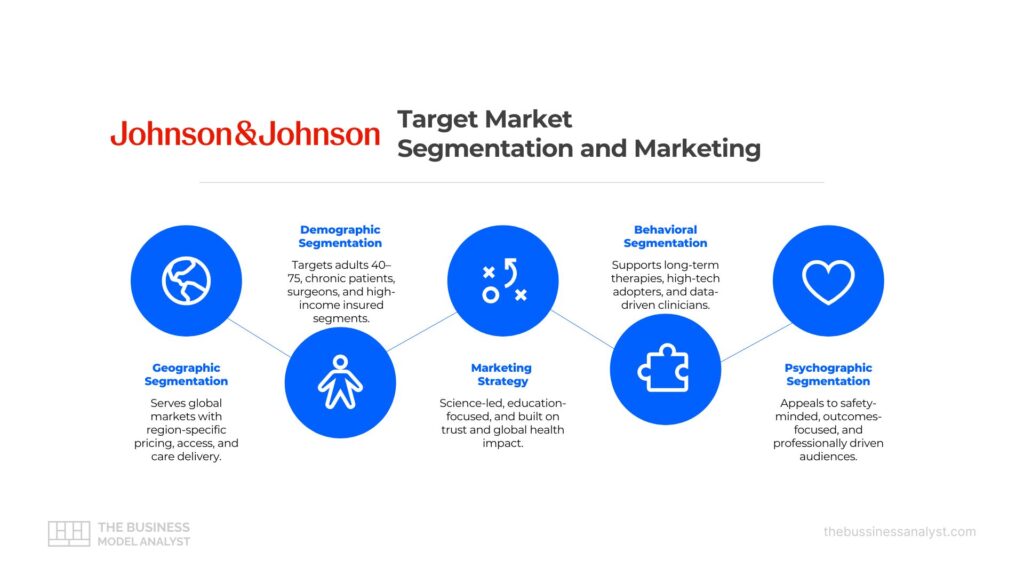
The Johnson & Johnson target market is segmented using four primary criteria: demographic, geographic, behavioral, and psychographic. Each plays a unique role in how the company develops, markets, and distributes its medical and pharmaceutical offerings.
Demographic segmentation helps J&J identify key patient populations for treatments like oncology drugs or joint replacements. Geographic segmentation allows the company to tailor offerings by country, health system, and regulatory environment. Behavioral segmentation informs product design and patient engagement, especially for long-term therapies. Finally, psychographic segmentation highlights how J&J appeals to professional and emotional values such as trust, innovation, and care.
By combining these segmentation types, Johnson & Johnson creates precision-focused marketing and development strategies. Whether launching a new immunology drug or promoting a surgical robotics system, each campaign is shaped by deep audience understanding.
Demographic Segmentation
Demographic segmentation involves categorizing the market based on quantifiable characteristics such as age, gender, income, education, and occupation. For Johnson & Johnson, this segmentation helps tailor messaging and products to specific patient groups, clinicians, and institutional buyers with distinct health needs and purchasing power.
Age and Health Needs
Johnson & Johnson primarily serves middle-aged to elderly populations, especially in its pharmaceutical division. Patients aged 40 to 75 are the largest consumers of medications for chronic conditions such as rheumatoid arthritis, cancer, cardiovascular disease, and diabetes. For example, its immunology products like Stelara target adults with long-term autoimmune disorders, while oncology drugs serve older patients battling cancer.
J&J also segments younger demographics, especially in pediatric and maternal health through vaccines, neonatal care, and women’s health. Its long-standing collaboration with global health organizations addresses childhood immunizations in developing nations, further emphasizing its age-focused strategy.
Gender and Health Focus
While many J&J products are gender-neutral, some divisions focus on specific gendered health needs. In its surgical technologies and oncology segments, Johnson & Johnson develops solutions specifically for women’s health, such as gynecological surgical tools and breast cancer treatments. Simultaneously, it provides care for male-specific cancers like prostate through precision medicine strategies.
Income and Insurance Coverage
J&J’s products often fall into premium pricing tiers due to their clinical efficacy and innovation. As such, it targets patients with private insurance or public health coverage, which allows access to high-cost biologics, surgical implants, or robotic systems. The company also serves low-income populations through public health programs and tiered pricing strategies, especially in developing nations.
Education and Professional Role
In the B2B segment, Johnson & Johnson targets highly educated healthcare professionals—surgeons, pharmacists, oncologists—who demand rigorous scientific evidence. Product literature, clinical trial data, and academic conferences are core to J&J’s engagement, reflecting its alignment with credentialed, decision-making professionals.
Demographic insights allow Johnson & Johnson to remain effective across a broad yet well-defined audience, aligning product design and messaging with life stage, health needs, and income access.
Geographic Segmentation
Geographic segmentation divides a market based on location, such as country, region, city size, or urban vs. rural settings. For Johnson & Johnson, a global company operating in over 60 countries, tailoring products and strategies to fit regional health systems, cultural expectations, and regulatory environments is critical.
Global Reach with Local Precision
Johnson & Johnson’s pharmaceutical and medical device businesses serve developed and emerging markets alike. In North America and Western Europe, the company focuses on cutting-edge medical technologies, specialty pharmaceuticals, and partnerships with sophisticated healthcare systems. These regions account for a large share of the company’s revenue due to high healthcare spending and insurance penetration.
In contrast, J&J’s strategy in emerging markets like India, Brazil, and sub-Saharan Africa often emphasizes affordability, access, and infrastructure development. The company collaborates with governments and NGOs to distribute essential medicines and surgical tools at tiered pricing, adapting to local healthcare economics.
Urban vs. Rural Healthcare Needs
In urban areas, Johnson & Johnson markets advanced surgical systems, such as the VELYS Robotic-Assisted Solution for orthopedic procedures, to major hospitals. In rural settings, especially in developing countries, it focuses on essential care products, including basic surgical kits, maternal health solutions, and generic medications, where infrastructure may be limited.
Localized Marketing and Compliance
J&J’s marketing campaigns are tailored to meet regional regulations and cultural expectations. For example, in Japan, the company emphasizes regulatory compliance and product precision, while in Latin America, campaigns may focus more on access and community outreach. Local subsidiaries help ensure compliance with health authorities and tailor branding to resonate with local values.
Geographic segmentation enables Johnson & Johnson to maintain relevance across vastly different healthcare environments, ensuring its solutions meet both clinical and cultural expectations.
Behavioral Segmentation
Behavioral segmentation focuses on how individuals interact with a brand or product—based on usage frequency, purchase habits, product loyalty, and response to engagement efforts. For Johnson & Johnson, understanding these behaviors helps the company optimize patient outcomes and professional adoption of its medical innovations.
Patient Behavior and Treatment Adherence
In its pharmaceutical business, Johnson & Johnson targets patients who require long-term treatment for chronic conditions like multiple myeloma or Crohn’s disease. These patients often engage with healthcare systems regularly and need consistent medication regimens. J&J supports adherence through patient assistance programs, educational resources, and reminder systems that reinforce therapy continuity.
For example, Janssen CarePath provides support services such as cost information and adherence tools tailored to specific medications. This not only improves patient outcomes but also fosters brand loyalty and repeat use of J&J therapies.
Professional Behavior and Technology Adoption
J&J’s medical device division focuses on surgeon behavior and preferences, particularly their openness to adopting new technologies. The company regularly hosts surgical workshops and training labs to introduce tools like orthopedic implants or robotic systems, thereby reducing adoption friction. Surgeons who attend such programs are more likely to integrate J&J technologies into their routine practice.
The company also relies on key opinion leaders (KOLs)—influential doctors or researchers—to champion products in clinical settings and academic journals, shaping peer behaviors and building trust across professional networks.
Purchase Behavior and Institutional Buying
Hospitals and clinics are major buyers of J&J devices and medicines. These institutional customers often make decisions based on clinical efficacy, reliability, cost-effectiveness, and support services. Johnson & Johnson engages these buyers with data-driven product presentations and long-term service agreements, encouraging ongoing relationships and bulk procurement.
By monitoring behavioral trends—such as how quickly a new device is adopted, how often a patient refills a prescription, or how satisfied professionals are with training—J&J continuously refines its offerings and support programs. This adaptive strategy strengthens its positioning in a highly competitive healthcare landscape.
Psychographic Segmentation
Psychographic segmentation explores the psychological traits, values, lifestyles, and beliefs that influence consumer behavior. For Johnson & Johnson, understanding the emotional and identity-driven aspects of its audience helps shape a brand message that resonates on a human, empathetic level—crucial in healthcare.
Values: Trust, Safety, and Innovation
Johnson & Johnson targets individuals and institutions that value clinical integrity, safety, and scientific leadership. Healthcare professionals choose J&J because it aligns with their own standards of patient care, research-based decision-making, and commitment to outcomes. Campaigns and materials emphasize rigorously tested solutions, often citing peer-reviewed studies, FDA approvals, or global health endorsements.
For patients, trust is deeply emotional—especially when dealing with life-threatening illnesses. The company cultivates this through long-standing credibility and partnerships with nonprofits and public health systems. Emotional security in treatment choices is a key psychographic factor.
Lifestyle and Professional Identity
In its B2B segment, J&J speaks to the professional identity of surgeons, pharmacists, and hospital administrators. These individuals often see themselves as innovators or healers, and Johnson & Johnson positions its tools and drugs as empowering solutions that help them deliver better care. The emotional reward of saving lives or improving mobility reinforces loyalty to the brand.
Emotional Triggers in Messaging
J&J campaigns frequently focus on hope, empowerment, and care. For example, its oncology advertisements might show real patient stories that emphasize resilience and support, appealing to both patients and caregivers. In surgical technologies, messaging highlights precision and control, tapping into the surgeon’s need for confidence and excellence.
These psychographic insights allow J&J to create targeted messaging that moves beyond function to emotion—essential when the stakes are high. In doing so, the company maintains a strong emotional connection with both professionals and patients.
Johnson & Johnson Marketing Strategy
Johnson & Johnson’s marketing strategy is centered around credibility, education, and emotional resonance. Given its focus on pharmaceuticals and medical technology, the company avoids broad consumer tactics and instead uses specialized channels that target healthcare professionals, institutions, and patients managing serious conditions.
Key channels include medical journals, healthcare conferences, webinars, and training programs—especially for its DePuy Synthes and Ethicon device brands. These platforms allow J&J to showcase innovations backed by clinical data, appealing to the analytical mindset of medical professionals. The brand often partners with key opinion leaders to lend further credibility.
For patients, J&J’s pharmaceutical brands like Stelara or Darzalex are supported through digital patient education campaigns, condition-specific websites, and social media outreach. Emotional storytelling, testimonials, and doctor-patient interaction videos are used to build connection and hope around treatments.
Rather than focus on flashy marketing, Johnson & Johnson emphasizes expertise, safety, and compassion—crafting a message that aligns with both the scientific mindset of professionals and the emotional needs of patients. This dual approach strengthens its trustworthiness in a highly regulated and emotionally charged industry.
How Johnson & Johnson Reaches Its Audience
Johnson & Johnson uses a mix of highly targeted communication channels to engage its core audiences—primarily healthcare professionals, institutional buyers, and patients with chronic or complex medical conditions. Each outreach strategy is adapted to the informational, emotional, and professional needs of the audience it addresses.
Medical Conferences and Professional Training
Johnson & Johnson frequently participates in and sponsors major medical conferences such as the American College of Cardiology or the European Society for Medical Oncology. These events allow the company to introduce new clinical data, showcase device innovations, and provide hands-on experience through training labs or workshops. This face-to-face strategy deepens relationships with surgeons, physicians, and hospital decision-makers.
Additionally, the company runs its own training centers and online modules through platforms like the Johnson & Johnson Institute, which educates tens of thousands of healthcare professionals globally. These courses help practitioners stay up-to-date with the latest medical advancements, reinforcing J&J’s role as a trusted knowledge partner.
Digital and Educational Platforms
To reach patients and caregivers, Johnson & Johnson builds disease-specific digital platforms such as MyPsoriasisTeam or Darzalex.com, which provide treatment guidance, support services, and patient testimonials. These tools encourage engagement and adherence by addressing emotional concerns and treatment literacy in simple, empathetic language.
J&J also uses targeted digital advertising, particularly on search engines and social media platforms like Facebook and LinkedIn, to drive traffic to these resources. Ads are often condition-specific and include calls to action for learning more or enrolling in support programs.
Healthcare Provider Engagement
For hospitals and clinics, J&J uses sales teams, procurement partnerships, and long-term contracts. These relationships are supported by health economics data and implementation support, such as device training and post-sale consultation. Strategic alliances with hospital networks allow J&J to integrate solutions into broader care models—particularly for surgical robotics or orthopedic implants.
Advocacy and Public Health Partnerships
Johnson & Johnson also partners with nonprofits, advocacy groups, and public health institutions to build outreach campaigns around vaccination, maternal health, and chronic disease awareness. These efforts not only educate at-risk populations but also reinforce the company’s commitment to equitable healthcare.
Through this blend of professional education, patient support, and institutional collaboration, J&J effectively reaches a complex, global audience.
Comparison to Competitors’ Target Audience
To better understand the Johnson & Johnson target market, it’s helpful to compare it with key competitors in the healthcare and pharmaceutical space. Two notable competitors—Pfizer and Medtronic—offer similar products but appeal to slightly different segments based on their strategic focus and product categories.
Johnson & Johnson vs Pfizer Target Audience
Both Johnson & Johnson and Pfizer operate in the pharmaceutical space, targeting patients with chronic or serious illnesses and the healthcare professionals who treat them. However, their approaches diverge in scope and positioning.
Pfizer often focuses on mass-market pharmaceutical solutions, such as vaccines (e.g., its COVID-19 vaccine with BioNTech), anti-infectives, and cardiology medications. This makes Pfizer more prominent in public health and primary care, engaging general practitioners and public health agencies worldwide. Its target audience includes patients of all ages, particularly in preventative care.
In contrast, J&J’s pharmaceutical arm, Janssen, concentrates more on specialty medicine—targeting patients with oncology, immunology, and neuroscience conditions. Its audience includes specialists (e.g., oncologists, rheumatologists) and patients who require long-term treatment regimens. This narrower, high-value focus aligns with J&J’s strengths in precision therapies and patient support programs.
Johnson & Johnson vs Medtronic Target Audience
Medtronic is a direct competitor in the medical technology space, and while both companies target surgeons and hospitals, their product categories shape distinct audience preferences.
Medtronic specializes in cardiac devices, diabetes management systems, and neurological implants, appealing heavily to cardiologists, endocrinologists, and neurologists. It targets patients with advanced cardiovascular or metabolic conditions, often relying on device-specific loyalty and digital monitoring tools.
J&J, through DePuy Synthes and Ethicon, focuses more on orthopedics, wound closure, and minimally invasive surgery. Its audience includes orthopedic surgeons, trauma centers, and surgical units, often those performing high-volume or complex procedures. J&J’s strength lies in surgical innovation and training, giving it an edge in hospitals seeking modern, adaptable solutions.
Similarities in Target Audiences
All three companies target healthcare professionals who are well-educated, data-driven, and risk-conscious. They also engage institutional buyers and policymakers who influence procurement and public health access. Shared values include clinical efficacy, safety, and long-term health outcomes. Additionally, each brand creates patient-facing education and access programs that build loyalty and awareness.
Key Differences in Target Audiences
The biggest differences lie in specialization and scale. Pfizer leans into primary care and public health, with a mass-market reach. Medtronic dominates the cardiology and neurology sectors with advanced monitoring and implantable tech. Johnson & Johnson straddles both worlds but is more concentrated in surgical solutions and specialty care, where emotional connection and technical mastery are key to audience retention.
J&J also places significant emphasis on professional education, more so than competitors, making it particularly appealing to surgeons and specialists looking to expand their expertise through training.
Johnson & Johnson Advantages
- Strong Professional Education Network
J&J’s investment in the Johnson & Johnson Institute offers unmatched training to medical professionals, positioning it as a leader in practitioner development and fostering loyalty through education. - Broad Specialty Care Coverage
Unlike competitors who specialize narrowly, J&J spans immunology, oncology, orthopedics, and surgical technologies—giving it more touchpoints across the patient journey and strengthening brand relevance in multidisciplinary care. - Robust Patient Support Infrastructure
Through programs like Janssen CarePath, J&J offers cost guidance, access support, and adherence tools, enhancing patient satisfaction and long-term therapy continuation—especially in high-cost treatments. - Global Public-Private Partnerships
J&J maintains long-standing collaborations with organizations like WHO and GAVI, reinforcing its reputation as a global health leader and expanding access in underserved markets.
Johnson & Johnson Disadvantages
- Less Dominant in Primary Care
Unlike Pfizer, Johnson & Johnson doesn’t dominate general practice or preventative medicine, missing opportunities in mass-market pharmaceuticals that drive global volume and visibility. - Higher Price Sensitivity
Many of J&J’s advanced therapies and surgical products are premium-priced, making them less accessible in markets without strong insurance or government reimbursement. - Limited Consumer Brand Presence Post-Spin-off
Following the spin-off of its consumer division (now Kenvue), J&J no longer benefits from direct brand recognition with everyday users, reducing emotional familiarity in mainstream households. - Intense Competition in Surgical Devices
In orthopedics and surgical robotics, J&J faces stiff competition from Medtronic, Stryker, and Intuitive Surgical—forcing it to compete not only on innovation but also on price, service, and ecosystem integration.
Conclusion
The Johnson & Johnson target market is defined by its dual commitment to scientific excellence and patient-centered care. By focusing on healthcare professionals, institutional buyers, and patients with complex conditions, J&J effectively balances clinical credibility with emotional resonance. Its segmentation strategy—spanning demographic, geographic, behavioral, and psychographic dimensions—enables the company to tailor its approach across diverse audiences and regions.
Compared to competitors like Pfizer and Medtronic, Johnson & Johnson excels in specialty care and surgical innovation, but faces challenges in broader consumer recognition and affordability in some markets. Still, its investments in professional training, patient support, and global access initiatives set it apart as a leader in trust and reach.
As healthcare continues to evolve, J&J’s ability to refine its target market and adapt its messaging will be vital. The company’s deep understanding of its audience, coupled with a data-driven and emotionally aware strategy, positions it to remain a cornerstone of modern healthcare delivery.


