
What is a Value Proposition? And How to write one!
Apr
Have you ever landed on a company’s website, scrolled for a few seconds, and still had no idea what they actually offer—or why you should care? That’s not just bad design. It’s a missing or weak value proposition.
In a crowded market where attention spans are short and competition is fierce, businesses don’t get a second chance to make a first impression. Your value proposition is that first impression—it’s the clearest, most compelling reason someone should choose you over anyone else.
Whether you’re a startup founder refining your pitch, a marketer optimizing landing pages, or a consultant helping clients clarify their messaging, crafting a strong value proposition is a non-negotiable part of your strategy.
In this guide, you’ll learn:
- What a value proposition really is (and what it’s not)
- The key elements that make a good one
- A step-by-step process to write your own
- Real-world examples from top companies
- And common mistakes to avoid
Oh—and to make the process easier, we’ve included a free Value Proposition Canvas template you can download and use right away.
Let’s dive in.
Contents
What is a Value Proposition?
A value proposition is a clear, concise statement that communicates the unique benefit your product or service delivers to your target customer—and why it’s better than the alternatives.
In other words, it answers the question every potential customer is silently asking: “Why should I choose you?”
It’s not your slogan. It’s not your mission statement. And it’s definitely not a generic sales pitch.
A strong value proposition:
- Focuses on outcomes, not just features
- Speaks directly to a specific customer segment
- Highlights what makes your offer different and better
- Communicates value in one or two punchy sentences
Whether it’s placed on your homepage, landing page, pitch deck, or ad campaign, your value proposition is the backbone of all your marketing and messaging. If it’s weak or unclear, everything else suffers.
Up next, let’s break down the key elements that make a value proposition effective.
Key Elements of a Great Value Proposition
A compelling value proposition isn’t just clever wording—it’s built on five core elements that work together to deliver a clear, specific, and persuasive message. When these components are aligned, they tell your potential customer exactly why they should choose you.
Here’s what every great value proposition includes:
Target Customer
Your value proposition must start with clarity about who you’re serving. The more specific you are, the more relevant and powerful your message becomes.
Ask yourself: Who is the ideal person that will benefit most from what I offer?
Example: “For busy professionals looking for a healthier way to eat without spending hours in the kitchen.”
Problem or Need
Great value propositions address a problem your customer already knows they have—or one they’ll instantly recognize once you name it.
Ask yourself: What pain, frustration, or unmet need does my customer deal with on a regular basis?
Example: “They’re tired of wasting time on grocery shopping and meal prep after long workdays.”
Your Solution
This is where you introduce your product or service as the answer to the problem. Be specific and concise. Avoid technical details—those come later.
Ask yourself: How does my offer directly solve the problem?
Example: “Our ready-to-eat meal kits help you maintain a healthy diet with zero prep time.”
Benefit or Outcome
Features are what your product has. Benefits are what your customer gets. Focus on the outcome they’ll care about most—time saved, money earned, energy gained, stress reduced.
Ask yourself: What is the ultimate result the customer will experience?
Example: “Save time, eat better, and feel more energized throughout the day.”
Unique Differentiator
Finally, explain why someone should choose your solution instead of the next best alternative. What’s your edge?
Ask yourself: What do we offer that others don’t—or what do we do better than anyone else?
Example: “Unlike traditional meal kits, ours arrive fully cooked—just heat and enjoy in under 3 minutes.”
Together, these five elements form the foundation of a strong, high-converting value proposition. Miss one, and your message loses clarity. Nail all five, and your audience will know exactly why they should choose you.
How to Write a Value Proposition in 5 Steps
Crafting a value proposition isn’t about finding the perfect sentence on your first try—it’s about deeply understanding your audience and clearly connecting your offer to what they value most. This section will walk you through a structured five-step process to develop a value proposition that is both strategic and persuasive.
Step 1: Know Your Target Audience
The foundation of any great value proposition is a deep understanding of who you’re trying to reach. Without clarity on your ideal customer, you’ll struggle to write a message that resonates.
Start by answering:
- Who are they? (e.g. demographics, job roles, lifestyle)
- What do they care about?
- What frustrates or motivates them?
- What are they trying to achieve?
Example: A productivity app may target startup founders and solo entrepreneurs who are overwhelmed by daily distractions and need better focus to grow their business.
The more specific your audience, the more focused—and effective—your value proposition will be.
Step 2: Identify Their Pains and Gains
Once you’ve defined your target audience, you need to understand what they’re struggling with—and what they hope to achieve. This is where you uncover the emotional and practical drivers behind their decisions.
Break it down into two parts:
- Pains: What’s causing them frustration, stress, lost time, or lost money?
- Gains: What outcomes are they hoping for? What would success look like?
Use voice-of-customer insights if you have them—surveys, reviews, support tickets, or interviews can be goldmines for this.
Example: A project management tool might learn that small teams are overwhelmed by too many apps, and just want one place to organize tasks, files, and deadlines.
Pain = scattered communication
Gain = more clarity and control in daily operations
By framing your value proposition around these insights, you speak to what truly matters to your audience.
Step 3: Map Your Offer to Those Needs
Now that you know who your customer is and what they care about, it’s time to connect the dots between their needs and what you offer.
This step is about aligning your product’s features and benefits with the specific pains and gains you’ve identified. You’re not just listing what your product does—you’re showing how it solves real problems or delivers meaningful results.
Approach:
- For each pain point, list how your product addresses it.
- For each desired gain, describe how your solution helps achieve it.
- Prioritize the most valuable or differentiating features.
Example: If your target audience struggles with time-consuming team communication (pain), and wants more productive collaboration (gain), you might position your solution like this:
“Our platform replaces five separate tools and brings messaging, file sharing, and task tracking into one simple dashboard—so your team spends less time managing tools and more time getting work done.”
This mapping becomes the foundation for writing your actual value proposition.
Step 4: Write and Refine Your Value Statement
With your insights in place, you can now craft the actual value proposition. The goal is to express what you offer, who it’s for, and why it’s valuable—in the clearest, most compelling way possible.
Start with a draft using a simple structure like:
“We help [target audience] who [have a specific problem or need] by providing [your solution], so they can [benefit or desired outcome]. Unlike [alternative], we [unique differentiator].”
Then, refine it by making sure it meets these criteria:
- Clear: Avoid buzzwords or vague claims.
- Specific: Speak to a real, defined customer segment.
- Benefit-focused: Emphasize outcomes, not just features.
- Concise: Aim for 1–2 sentences.
Example (refined): “Notion is an all-in-one workspace for teams and individuals who want to write, plan, and get organized—all in one place. Unlike using separate apps for notes, tasks, and collaboration, Notion keeps everything connected and easy to manage.”
This is not a slogan—it’s your positioning statement. You’ll refine the tone later depending on where you use it (landing pages, ads, decks, etc.), but this version should work as your strategic foundation.
Step 5: Test Your Message with Real Users
A value proposition doesn’t live in a vacuum—it needs to resonate with the people you’re trying to reach. That’s why testing and refining it based on feedback is just as important as writing it. Just as students often check papersowl reviews before deciding if the writing service delivers what it promises, your audience does the same—they look for proof that your message is clear and valuable before taking action.
Here’s how to do it:
- Use it in real contexts: Add it to your homepage, landing pages, email campaigns, or ad creatives.
- Collect feedback: Ask users or leads if the message is clear and compelling. Watch for confusion, indifference, or lack of engagement.
- A/B test variations: Try different phrasings or angles and measure which one leads to better conversions, click-through rates, or replies.
- Pay attention to questions: If prospects keep asking, “So what do you actually do?”—your value proposition needs improvement.
Remember: Clarity is more important than cleverness. If people don’t immediately understand what you do and why it matters, they won’t stick around to figure it out.
By testing and iterating, you ensure your message actually works in the real world—and drives real results.
Where the Value Proposition Fits in Your Business Model
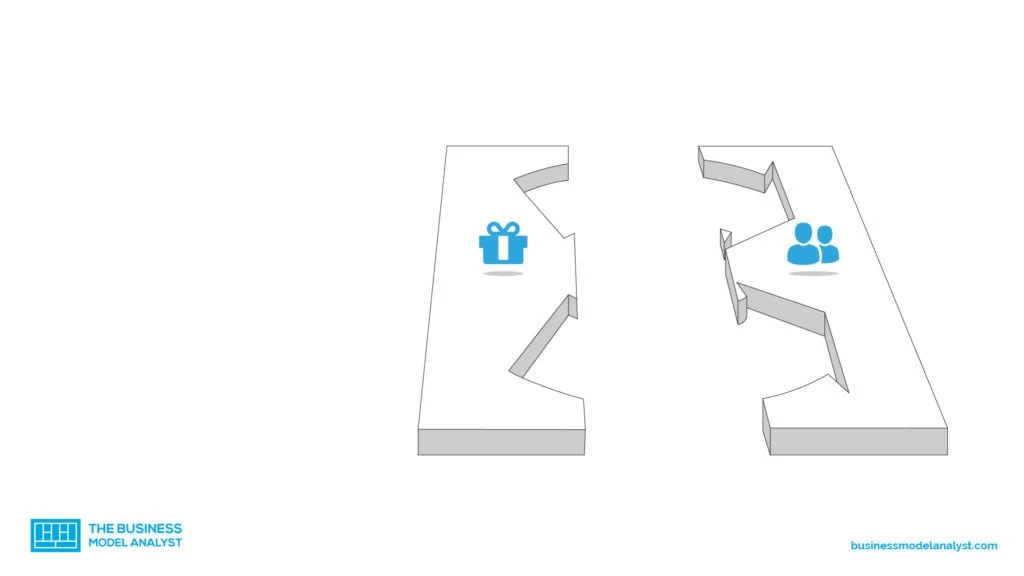
In the Business Model Canvas framework, the Value Proposition block comes directly after the Customer Segment block.
This order is intentional: You can’t define value without first knowing who you’re creating it for.
Your value proposition is about the products and services that solve problems or create benefits for a specific group of people. These benefits can be:
- Quantitative — such as price, speed, efficiency, or savings
- Qualitative — such as style, innovation, brand perception, or experience
A well-defined value proposition is the core reason a customer will choose your brand over others. And because it directly connects customer insights with what your company offers, it’s one of the most critical elements in your overall business model.
So before writing your value proposition, make sure your customer segments are clearly defined—because all value begins with understanding who it’s for.
Value Proposition vs Mission Statement
The terms value proposition and mission statement are often confused—but they serve very different purposes in your business strategy.
Here’s a breakdown of the differences:
| Aspect | Value Proposition | Mission Statement |
| Primary Audience | External (customers, prospects) | Internal and external (employees, partners, general public) |
| Purpose | Explains why a customer should choose your product or service | Describes the company’s purpose and long-term direction |
| Focus | Customer value, benefits, and differentiation | Company vision, principles, and reason for existing |
| Tone | Persuasive and benefit-driven | Inspirational and purpose-driven |
| Placement | Often featured on websites, landing pages, pitch decks, and ads | Typically found in About pages, internal documents, or brand guidelines |
Practical Example
Value Proposition (Slack): “Slack is the productivity platform that brings the right people, information, and tools together to get work done.”
Mission Statement (Slack): “To make people’s working lives simpler, more pleasant, and more productive.”
As you can see, the value proposition is specific, benefit-oriented, and directly customer-facing. The mission statement is broader and reflects the company’s overall purpose.
Both are important—but only one is designed to convert leads into customers.
We have an article covering the Slack business model where we talk about their value proposition, and another one on Slack mission statement if you want to dive deeper.
Why a Strong Value Proposition Matters
Your value proposition isn’t just a marketing line—it’s the foundation of how you communicate your offer. When it’s done right, it makes everything else in your business clearer and more effective.
Here’s why it plays such a critical role:
- Boosts conversions: A clear value proposition immediately tells visitors why they should stay—and why they should act. It helps turn traffic into leads and leads into customers.
- Attracts the right audience: When your message is focused, it speaks directly to the people who need your solution most—and naturally filters out those who aren’t a fit.
- Strengthens brand alignment: Your value proposition becomes a reference point for your team. It ensures consistency across product development, marketing, and customer service.ahrefs
- Creates a competitive edge: In crowded markets, differentiation matters. A strong value proposition highlights what makes you different and better—so you stand out, even when others offer similar features.
- Clarifies your customer promise: It forces you to focus on what matters most: the result or transformation your customer is really buying—not just the product features.
Free Value Proposition Canvas Template (Download)
Writing a value proposition from scratch can feel overwhelming—especially when you’re trying to distill everything your business offers into one clear message. That’s where the Value Proposition Canvas comes in.
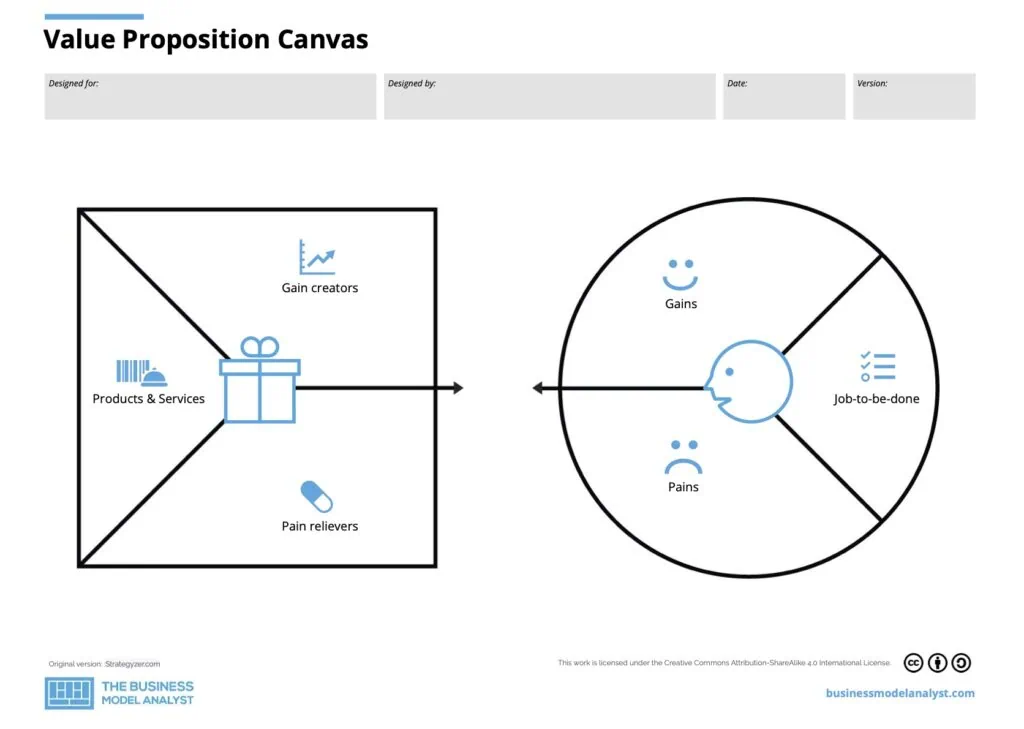
It’s a visual tool designed to help you map the core elements of your value proposition in a structured, strategic way. By breaking your thinking into two sides—customer profile and value map—you can clarify how your product solves real problems and delivers meaningful benefits.
With our free downloadable template, you’ll be able to:
- Identify your ideal customer’s pains, gains, and jobs to be done
- Outline your products and services in a way that directly addresses those needs
- Spot gaps between what you offer and what your audience actually values
Value Proposition Examples (from Real Companies)
Let’s look at how some of the most successful companies in the world craft their value propositions—and why they work. Each of these value proposition examples reflects the key elements we’ve discussed: clarity, customer focus, and differentiation.
Slack
“Slack is the productivity platform that brings the right people, information, and tools together to get work done.”
Why it works: Slack doesn’t lead with features—it leads with outcomes. The message is clear and specific: it’s about improving productivity through better collaboration. It speaks directly to teams overwhelmed by scattered communication, and it positions Slack as the central hub for streamlined work.
Airbnb
“Book unique places to stay and things to do — all over the world.”
Why it works: Airbnb focuses on experience, not just accommodation. The word “unique” immediately communicates differentiation, and the global reach is highlighted up front. It appeals to travelers who want something more personal and adventurous than a standard hotel stay.
Uber
“Tap the app, get a ride.”
Why it works: This is a masterclass in simplicity. Uber distills its value down to two actions: open the app, and get where you need to go. It communicates convenience, speed, and ease of use—all within five words. The value proposition matches the product experience perfectly.
Each of these companies has a different audience, industry, and style—but all three value propositions are clear, concise, and focused on real customer benefits.
Common Mistakes to Avoid
Even with a solid framework, it’s easy to fall into traps that weaken your value proposition. Below are some of the most common mistakes—along with quick examples to help you spot and fix them.
Being too vague or generic
If your value proposition could apply to any business in your category, it won’t stand out. Avoid broad claims like “We deliver solutions for all your needs.”
Weak: “We help businesses grow.”
Stronger: “We help SaaS startups scale their customer acquisition with AI-driven ad campaigns.”
Focusing on features, not benefits
Customers don’t buy products—they buy outcomes. Listing features without context misses the emotional and practical value of what you offer.
Weak: “Includes 30GB of cloud storage and auto-sync.”
Stronger: “Access your files anywhere, anytime—without worrying about losing a single update.”
Using jargon or buzzwords
Terms like “cutting-edge,” “innovative,” or “next-gen solutions” are often meaningless without specifics. Aim for clarity over cleverness.
Weak: “A dynamic and synergistic platform for business enablement.”
Stronger: “One tool to manage your projects, deadlines, and team communication—all in one place.”
Ignoring the customer’s actual pain points
A common mistake is writing from your company’s perspective rather than the customer’s. Focus less on what you do, and more on what the user gains.
Weak: “We’re a top-rated digital agency with 15 years of experience.”
Stronger: “We help e-commerce brands convert more visitors into buyers—through better design and faster pages.”
Trying to say too much
Your value proposition isn’t your full pitch. Keep it short and focused. You can elaborate in other parts of your website or sales flow.
Tip: One sentence is often enough. Two is fine. Three is pushing it.
Conclusion
A strong value proposition isn’t just a nice-to-have—it’s the backbone of your business strategy and communication. It’s the first thing your potential customers need to understand, and the last thing that should ever be unclear.
When you take the time to define:
- Who you serve
- What problem you solve
- How your solution works
- The outcome you deliver
- And why you’re different
—you position your business to attract the right audience, stand out in a crowded market, and convert attention into action.
If you haven’t already, download our free Value Proposition Canvas Template to map out your own value proposition in a clear, structured way. Use it to brainstorm ideas, align with your team, and refine your message until it resonates.
Clarity sells. Start there.

