20 Mental Models Examples to Put in Practice

Apr
Every day, entrepreneurs and decision-makers are bombarded with complexity. From evaluating new business opportunities to solving internal bottlenecks, the mental load can be overwhelming. That’s where mental models come in.
Mental models are thinking frameworks — shortcuts that help you make smarter decisions by simplifying how you view problems. They’ve been used by world-class thinkers like Elon Musk, Jeff Bezos, and Charlie Munger to consistently outthink the competition. In this article, you’ll discover powerful mental models examples that you can apply in your own business and life. Whether you’re launching a startup, refining a strategy, or just want to think more clearly, these models will sharpen your thinking and elevate your results.
Contents
Mental Models Examples
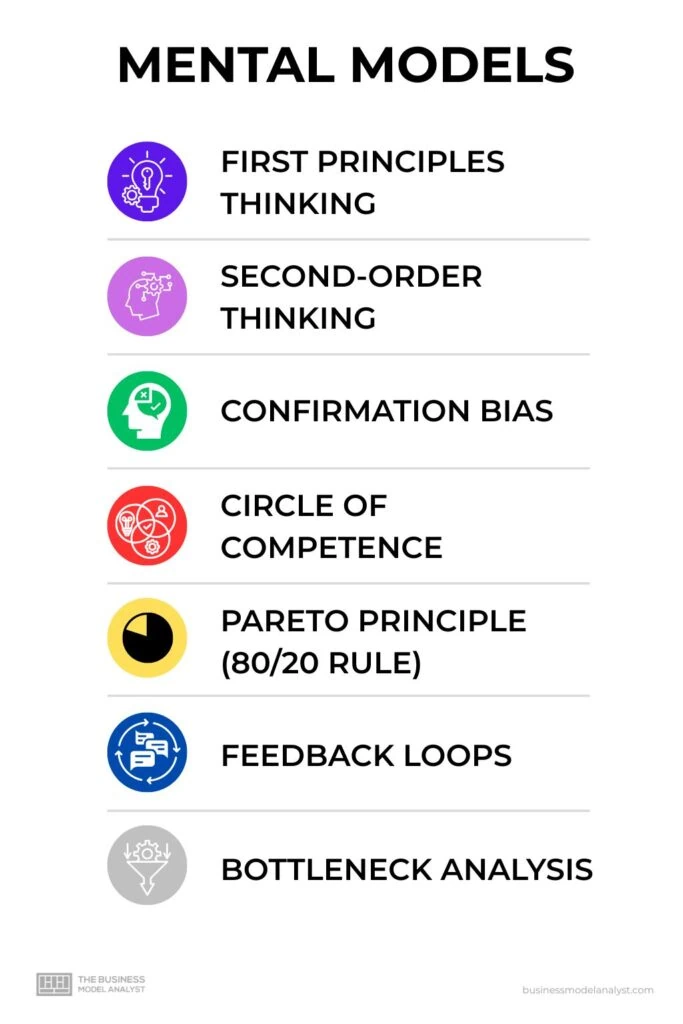
To make them easier to apply, we’ve grouped the most useful mental models into five categories. Each category covers a different area of thinking, from decision-making to strategy and systems thinking.
Decision-Making Models
These models help you think critically, assess risks, and make better choices under uncertainty.
- First Principles Thinking: Break a problem down to its fundamental truths and build from there.
- Inversion: Instead of asking “What should I do?”, ask “What should I avoid?”
- Opportunity Cost: Every choice has a cost — what are you giving up by choosing one path over another?
- Second-Order Thinking: Consider not just the immediate results of a decision, but the long-term ripple effects.
Psychology-Based Models
These help you understand how your brain (and your customer’s brain) can trick you.
- Confirmation Bias: We tend to seek out information that confirms what we already believe.
- Availability Heuristic: We judge things as more likely if they’re easier to recall — not because they’re true.
- Pavlovian Association: Emotional associations can shape behavior — even if they’re irrational.
- Loss Aversion: People fear losses more than they value gains — a key insight for pricing and product design.
Business Strategy Models
These are especially powerful for entrepreneurs building competitive and scalable businesses.
- Circle of Competence: Stay within areas where you truly understand the game.
- Comparative Advantage: Focus on what you can do better than anyone else, even if others can do it too.
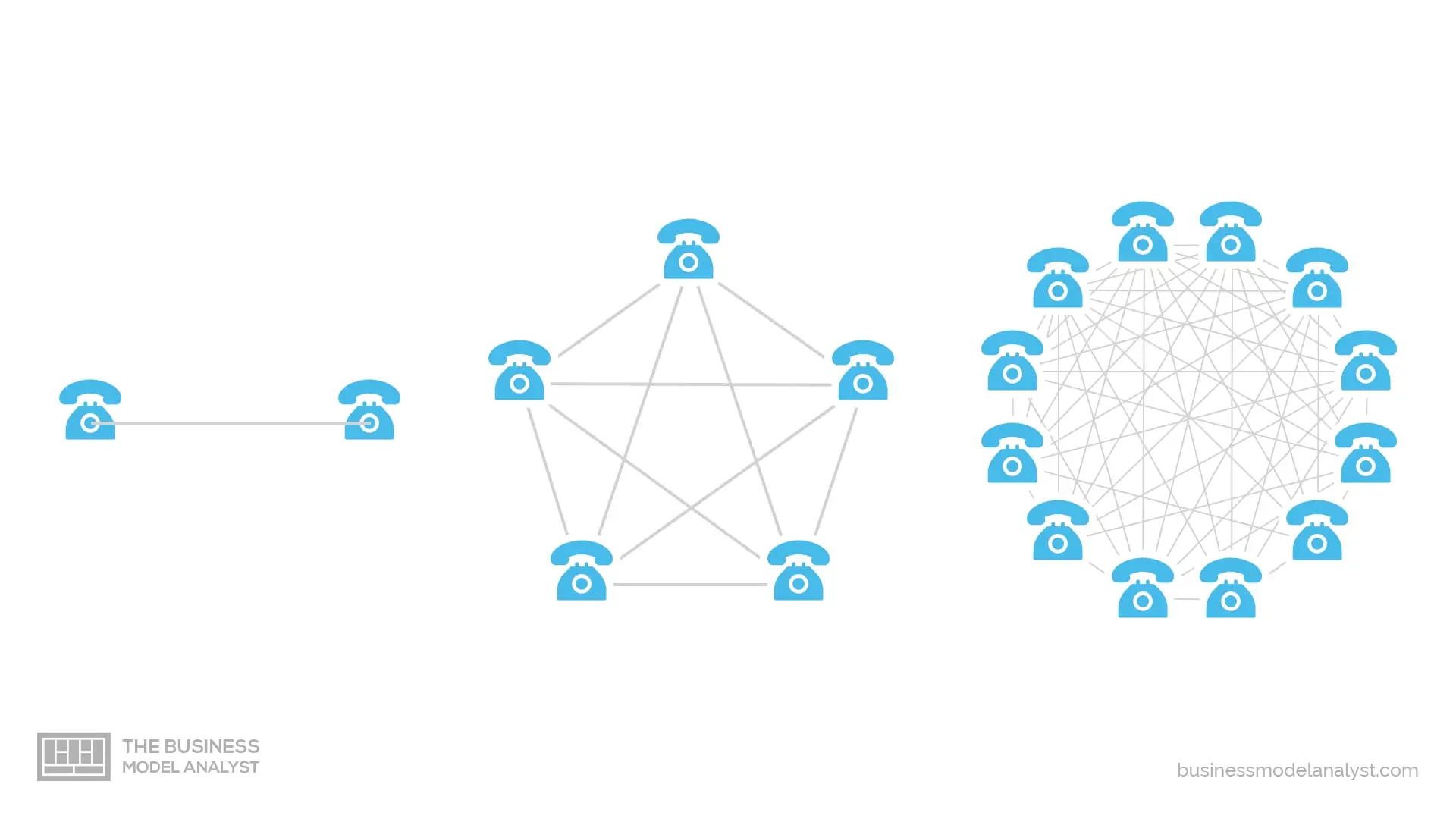
- Network Effects: The more people use your product, the more valuable it becomes (think WhatsApp or Uber).
- Switching Costs: How hard is it for customers to leave you? High switching costs build loyalty and retention.
Productivity and Personal Growth Models
Optimize how you use your time, energy, and attention.
- Eisenhower Matrix: Prioritize tasks by urgency and importance.
- Pareto Principle (80/20 Rule): 80% of results come from 20% of actions — identify the vital few.
- Parkinson’s Law: Work expands to fill the time available — set shorter deadlines to move faster.
- Time Blocking: Structure your day into focused blocks of time to avoid multitasking.
Systems Thinking Models
These help you think beyond linear cause-and-effect, especially useful in managing businesses and teams.
- Feedback Loops: Positive loops amplify results; negative loops stabilize systems.
- Bottleneck Analysis: A system is only as fast as its slowest part — identify and fix constraints.
- Leverage Points: Small shifts in the right place can produce big changes.
- Critical Path: In project management, focus on tasks that directly impact the timeline.
What Are Mental Models?
A mental model is a way of understanding how the world works. It’s a framework you carry in your mind to simplify complexity, make decisions, and solve problems. Instead of reacting impulsively or guessing, mental models help you approach situations with clarity and structure.
Think of them as mental shortcuts or lenses. Just like using a map to navigate unfamiliar terrain, mental models help you navigate uncertainty in business, strategy, and life. They don’t guarantee success — but they increase your chances of making better, more rational choices.
In business, mental models can guide everything from product design to negotiation tactics. The more models you understand, the better your “toolbox” becomes for handling any challenge.
Why Entrepreneurs and Leaders Use Mental Models
Top entrepreneurs and business leaders rely on mental models because they provide structure in moments of uncertainty. In a fast-paced world where decisions must often be made with limited information, mental models offer a reliable way to filter noise and focus on what really matters.
Here’s why they’re essential in business:
- Clarity in Complexity: When faced with a new challenge, a good mental model can help break down the problem into manageable parts.
- Faster, Smarter Decisions: Models like the 80/20 Rule or First Principles Thinking help reduce time spent overanalyzing.
- Avoiding Cognitive Biases: By relying on proven mental frameworks, entrepreneurs can sidestep common thinking traps like confirmation bias or overconfidence.
- Strategic Thinking: Mental models promote systems thinking and long-term planning, essential for sustainable growth.
Whether you’re optimizing a business model, designing a product, or choosing between growth strategies, the right mental model can be a game-changer.
Real-World Examples of Mental Models in Action
Understanding a mental model is one thing — seeing it in action is where the real value lies. Here are some notable entrepreneurs and the mental models they’ve used to build world-changing companies.
Elon Musk – First Principles Thinking
When Musk set out to build SpaceX, he realized that buying ready-made rockets was too expensive. Instead of accepting that cost, he broke the problem down to first principles — asking what raw materials rockets are made of and why they cost so much. By reengineering the process from scratch, he built rockets at a fraction of the typical cost.
“You boil things down to the most fundamental truths…and then reason up from there.”
Jeff Bezos – Regret Minimization Framework
Before leaving his stable job to start Amazon, Bezos imagined himself at 80 years old, looking back on his life. He asked: Would I regret not doing this? That’s second-order thinking combined with a personal filter — what he later called his Regret Minimization Framework. It helped him make a bold decision with clarity.
Charlie Munger – Latticework of Mental Models
Warren Buffett’s partner Charlie Munger is perhaps the biggest advocate for using a wide variety of mental models. His approach is to build a latticework of models from different disciplines — economics, psychology, engineering — and apply them depending on the situation. This interdisciplinary thinking is why Munger is revered as one of the wisest investors of our time.
Steve Jobs – Inversion
Jobs often thought in reverse. For example, when designing the iPhone, he didn’t ask “How do we add more features?” but rather “What can we remove to make it simpler?” This inversion led to one-button designs and a frictionless user experience.
How to Apply Mental Models in Your Business
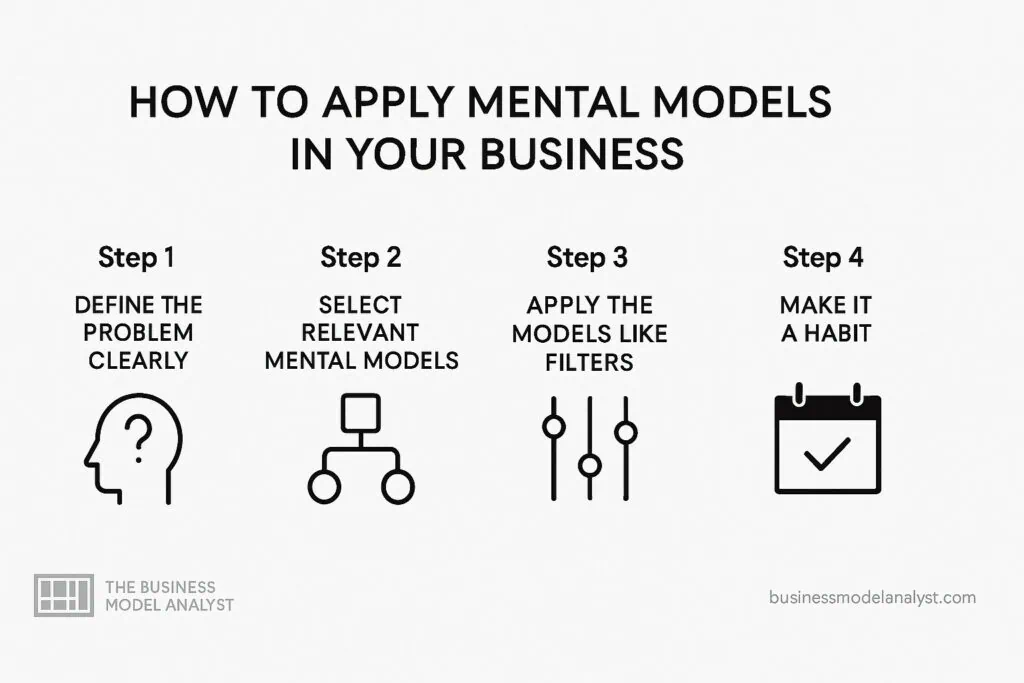
Knowing mental models is powerful — but using them consistently is what creates real leverage. Here’s how to integrate them into your business decision-making process.
Step 1: Define the Problem Clearly
Before choosing a model, clarify what you’re trying to solve. Is it a pricing issue? A growth bottleneck? A hiring decision?
Step 2: Select Relevant Mental Models
Once the problem is clear, choose 1–3 models that can offer insight. For example:
- Launching a new product? Use First Principles, Opportunity Cost, and Second-Order Thinking.
- Choosing between marketing channels? Try 80/20 Rule, Comparative Advantage, and Inversion.
- Managing a growing team? Use Bottleneck Analysis, Feedback Loops, and the Eisenhower Matrix.
Step 3: Apply the Models Like Filters
Don’t just use them for theory — run your idea through the model:
- What would First Principles thinking say about this budget?
- What would I do if I inverted this strategy?
- What are the second- and third-order consequences of this partnership?
Step 4: Combine Models for Better Results
Most high-level decisions require multiple mental models. For instance, when pricing a subscription service, you might apply:
- Loss Aversion (pricing psychology)
- Switching Costs (retention strategy)
- Opportunity Cost (comparing revenue streams)
- And even the Subscription Business Model itself as a mental framework
Step 5: Make It a Habit
The most successful entrepreneurs think in models by default. Start by applying just one or two consistently each week. Over time, your brain will instinctively reach for the right tool when a challenge appears.
Conclusion
Mental models are more than abstract concepts — they’re practical tools that can reshape how you think, decide, and lead. By adopting the mental habits of the world’s top entrepreneurs, you give yourself an edge in clarity, speed, and strategic insight.
Whether you’re building a startup, optimizing operations, or navigating uncertainty, the right mental model can help you cut through noise and make better decisions. Start small: pick one model, apply it today, and build your mental toolbox over time.
Remember — it’s not about knowing every model. It’s about using the right one, at the right time, for the right problem.