What is the difference between Business Model and Business Plan?
Sep
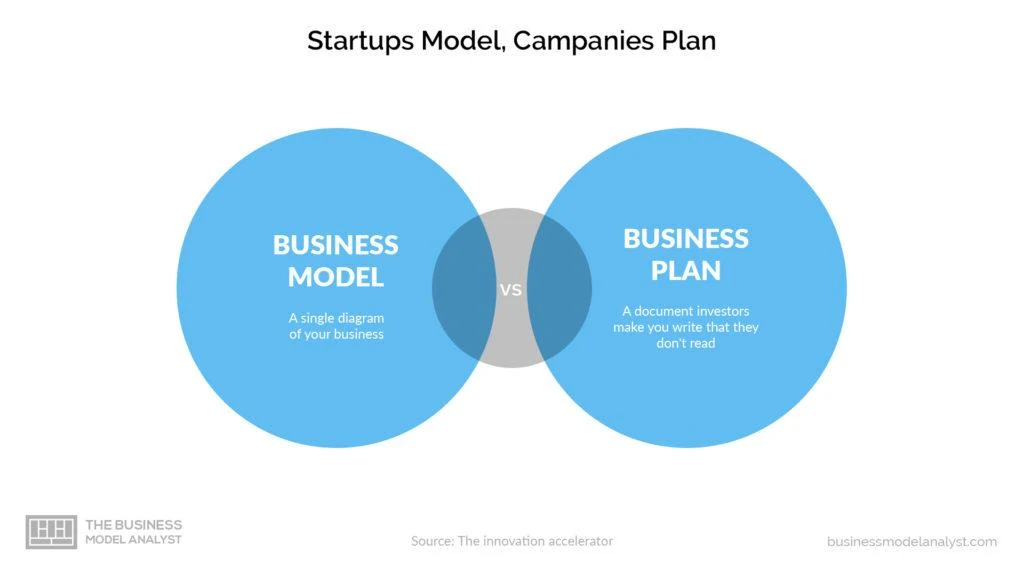
Many people confuse a business model with a business plan, but these are distinct tools with different roles in building and operating a business. Though they complement each other, they serve different functions and vary in complexity and purpose.
A business model is a high-level blueprint showing how a company creates, delivers, and captures value in a simple, often visual format. It describes the basics of how the company makes money, its target customers, its products or services, and how it sustains its competitive advantage. This model is usually outlined in one page or a concise framework, giving a clear snapshot of how the business operates.
In contrast, a business plan is a comprehensive document outlining the company’s goals, strategies, financial projections, and operational approach. It serves as a roadmap, guiding decisions and providing a detailed, long-term look at how the company will achieve its goals. A business plan often includes a business model description, along with sections on market research, team structure, funding requirements, and more.
Contents
Business Model Definition
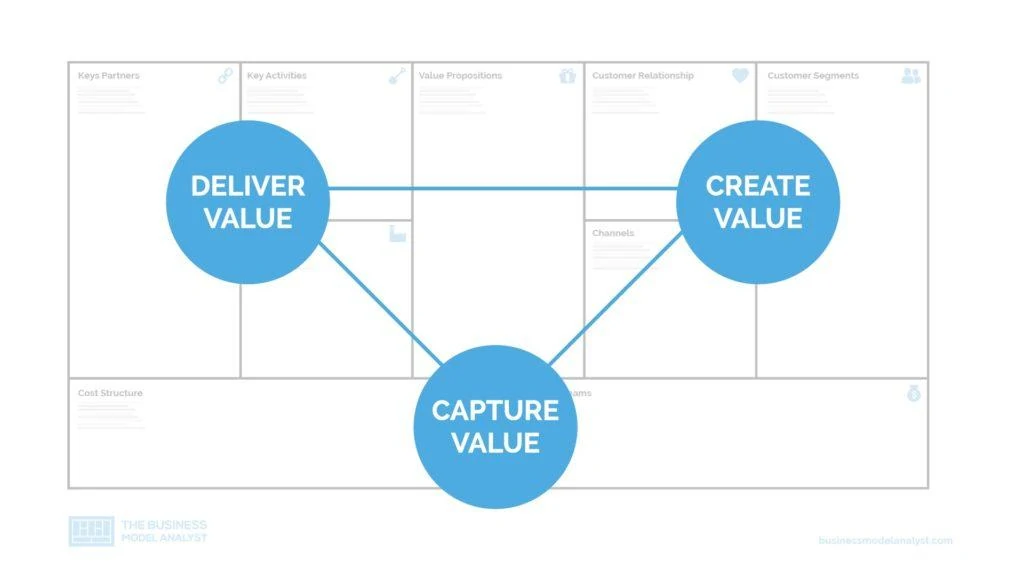
A company’s business model describes how it creates, delivers, and captures value. Consider examples like a restaurant franchise, a Software-as-a-Service (SaaS) provider, a razor-and-blade company, a subscription service, a freemium tool, an advertising-based business, or an e-commerce marketplace — each is a unique business model with specific elements.
The business model tool is often confused with the business plan, but it’s pretty different. This tool is a one-page framework, such as the Business Model Canvas, Value Proposition Canvas, or Lean Canvas, used to outline a business’s critical elements.
It highlights resources, key activities, customer relationships, and channels needed to make the company successful. For example, the Business Model Canvas is ideal for new businesses, while the Lean Canvas is suited for early startup validation, and the Value Proposition Canvas helps refine products.
In short, working on your business model gives you a clear, internal view of your business’s strategy rather than a detailed business plan. Now, let’s explore what a business plan offers.
Business Plan Definition

A business plan is a written document that contains detailed information on the business, product/service, market, and the entrepreneur’s vision for the company’s future. It is the most accurate portrait of the field, products and services, customers, competitors, suppliers, all the operational and financial goals of the company, and its marketing and sales strategy.
Its purpose is to display the business’s strengths and weaknesses and project the organization’s gains and losses to identify the idea’s viability and sustainability. The business plan is often a long document made up of several pages. In general, it contains:
- Cover;
- Table of Contents;
- Executive Summary;
- Business and product/service description;
- Market analysis;
- Competitive Analysis;
- Marketing Plan;
- Operational and Management Plan;
- Financial Plan;
- Supporting data and documents.
The goal of the business plan is to determine whether your idea is sustainable. It also shows the weaknesses to be repaired and the strengths to be potentialized. It is a kind of script that reduces the chance of failure.
The business plan is a core document if you are looking for partners to demonstrate profitability. Its focus is to provide executives, investors, and other stakeholders with a complete business overview. So, seeking loans, financing sources, and investments is vital. It is the best way to demonstrate that your business is trustworthy and solid enough for credit.
Business Model vs Business Plan
The difference between a Business Model and a Business Plan lies in critical aspects like how they should be developed, where the focus should be, how to organize ideas and their primary objectives. Both business models and business plans are essential documents that guide businesses in strategic planning, business objectives, and growth.
Purpose and Focus
A business model is a high-level outline explaining how a company creates, delivers, and captures value — defining its core purpose and operations. It serves as a foundation for model innovation and is often used as a planning tool to validate early-stage ideas or restructure existing businesses.
The business plan, however, is an in-depth document that aligns a company’s strategy with its financial projections. This makes it essential for planning business funding, growth, or even an IPO. This detailed plan is typically more comprehensive, serving as a business case for attracting investment or planning for long-term success.
Structure and Operational Details
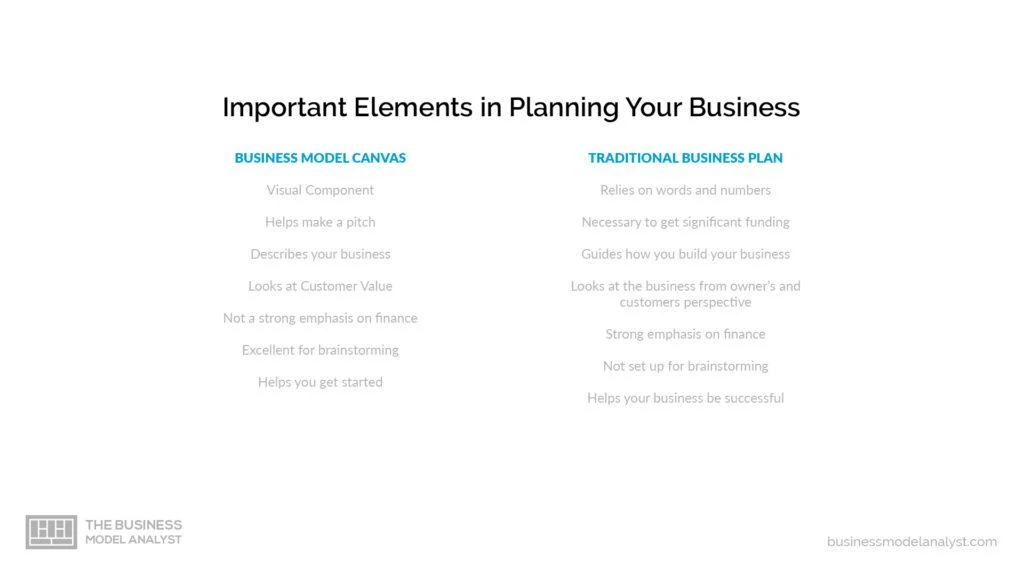
While a business model is concise and often displayed on a single page, such as in a Business Model Canvas, a business plan includes a detailed structure. This plan defines every aspect of a company’s operations, including the business objectives, team structure, marketing strategy, and processes needed to reach strategic goals.
A business plan becomes invaluable for strategic planning and plan writing, especially for large companies or those seeking external funding, as it provides a complete look at how each area contributes to the company’s plan.
Financial Projections and Success Metrics
The business model briefly highlights revenue streams and cost structure to assess profitability quickly. However, the business plan dives into extensive financial projections, offering detailed budgets, cash flow analysis, profit and loss statements, and break-even points.
This level of financial planning is crucial for investors, lenders, and stakeholders, making the business plan essential in securing business funding and ensuring the company’s strategy aligns with its financial goals.
When to Use Each Document
Both documents are valuable at different stages. Early-stage companies benefit from using a business model for quick hypothesis validation, while more established businesses may rely on a detailed business plan to solidify long-term strategies and business funding options. Whether using a plan template for startups or a custom-designed company’s plan for an IPO, having both tools aids in structured planning and contributes significantly to a company’s overall success.
Model Innovation and Adaptability
Model innovation is critical for evolving businesses. A flexible business model allows companies to pivot or expand their offerings in response to market changes, which can be incorporated into a new or updated business case.
Meanwhile, a comprehensive business plan can be revisited to refine projections, adjust for new objectives, or realign the company’s structure. This adaptability ensures that businesses are well-prepared for current demands and positioned for future growth.
Business models and business plans serve complementary purposes. Both are critical for effective planning and organization, ensuring the business is structured for immediate needs and long-term success.
Whatever the case, it is essential to understand that these terms have different purposes and have various tools to develop them. To summarize here, the key terms that are commonly confused with each other:
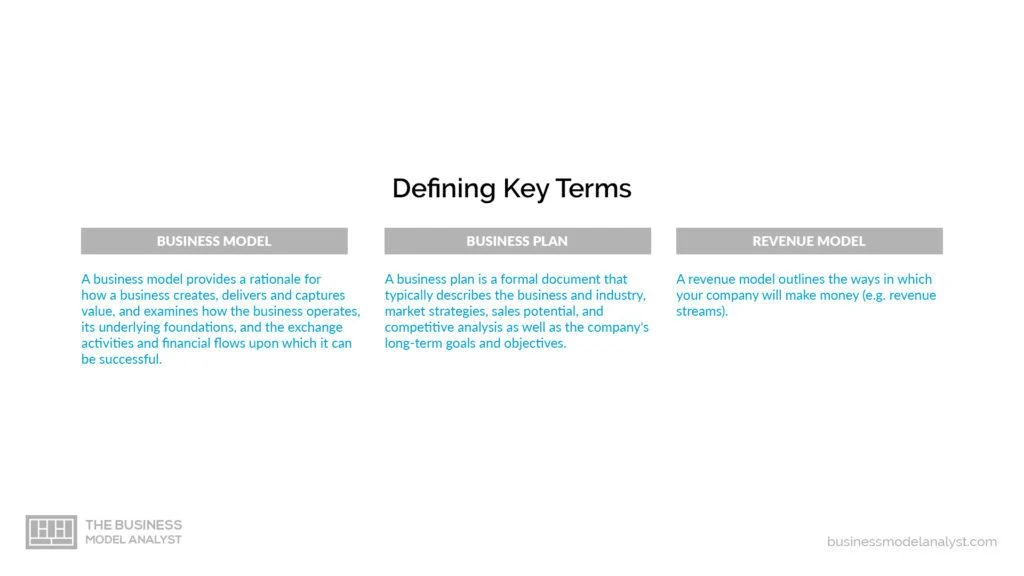
- Business model: Provides a rationale for how a business creates, delivers, and captures value, and examines how the company operates, its underlying foundations, and the exchange activities and financial flows upon which it can be successful;
- Business Plan: A formal document describing the business and industry, market strategies, sales potential, competitive analysis, and the company’s long-term goals and objectives;
- Revenue Model: Outlines how your company will make money (e.g., revenue streams).
Did you better understand the difference between Business Model and Business Plan? Comment below!
Business Models vs. Business Plans FAQ
1. Which comes first, a business model or a business plan?
A business model should come first. It outlines how the business creates and captures value, serving as the foundation for a more detailed business plan that includes strategy, operations, and financial projections.
2. How can a company test and validate its business model before creating a business plan?
A company can test and validate its business model by conducting market research, gathering customer feedback, creating a minimum viable product (MVP), and running pilot tests to ensure its product or service solves a real need and has demand in the market.
3. How often should a company review and update its business plan?
A company should review and update its business plan annually or sooner if market conditions, company goals, or operational needs significantly change. This ensures the plan remains aligned with the business’s current direction and growth.
4. Is a business model not a business plan?
No, a business model is not a business plan; a business model is a simplified framework of how a business creates and captures value, while a business plan is a comprehensive, detailed document outlining the company’s strategy, operations, and financial goals.
5. What are the four stages of a business model?
The four stages of a business model are typically ideation, where the concept is formed; validation, where the model is tested for feasibility; growth, where scaling strategies are developed; and maturity, where the model is optimized and maintained for sustainability.